
One defective part in the PCB of the car can not only be a defect but also a safety issue. That’s why SMT assembly in the automotive industry isn’t just about speed; it’s about absolute precision, consistency, and control.
The strain on PCB assembly lines is continually increasing as modern vehicles become increasingly electronics-based, such as ADAS systems and EV battery management. Two minor but significant components silently dictate the success of production in this environment: SMT feeders and SMT nozzle systems.
Let’s take a closer look at how these critical components influence not just efficiency, but the overall precision and consistency of automotive PCB assembly.
Why SMT Assembly in Automotive Is Different
Automotive PCBs work in harsh environments as compared to consumer electronics: heat, vibration, humidity, and long life cycles. This means:
- No tolerance to errors in placements.
- Great repeatability of large volumes of production.
- Adherence to the quality standards (such as IATF 16949) is strict.
The slightest discrepancy in the placement of components may cause a system failure in the long run. Feeders and nozzles have a defining role in this.
Role of SMT Feeders in PCB Assembly for Automotive.
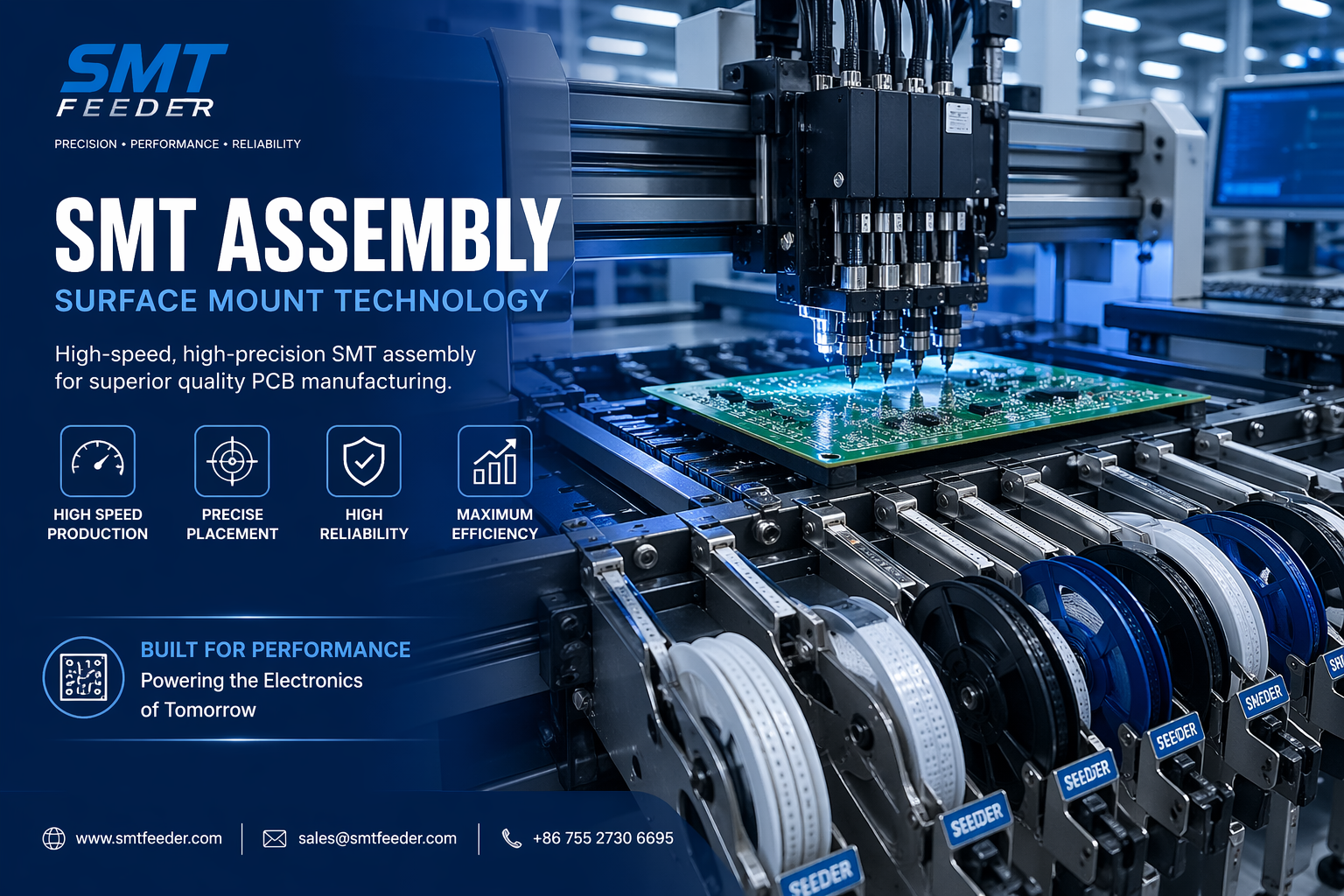
SMT feeders feed into the pick-and-place machine with components in an accurate and continuous fashion. It sounds easy – but when it comes to automotive production, the standards are far greater.
Poorly performing feeders may result in the following:
- Misfeeds or skipped components
- Increased machine downtime
- Inconsistent placement accuracy
- What is a Good SMT Feeder?
Feeders used in the automotive industry have to satisfy certain performance requirements:
1. High Feeding Accuracy
The components should be placed at the pickup location each time. Placement can be influenced by minor variations.
2. Long-run stability.
There is continuous production of automobiles. Feeders need to be stable in their operation without frequent recalibration.
3. Interoperability with a variety of components.
Feeders should support a wide range of component sizes (microchips to larger connectors) without affecting efficiency.
4. Low Maintenance Requirements
The constant interruption of the production process by feeder adjustments can interfere with the overall production. Dependable feeders minimize the human factor.
The Importance of SMT Nozzle Selection
While feeders deliver components, SMT nozzle systems are responsible for picking and placing them accurately on the PCB.
Nozzle performance directly influences:
- Placement accuracy
- Component integrity
- Production speed
- Prerequisites of SMT nozzles.
1. Precision Handling
Nozzles should not move or drop parts, particularly fine-pitch or delicate parts.
2. Good and firm vacuum control.
Suction imbalance may cause misplacement or loss of components during high-speed operations.
3. Material Durability
Continuous wear is subjected to nozzles. Materials of high quality provide durability and reliability.
4. Proper Nozzle Design of Each Component.
The nozzle shape and size depend on the component. The incorrect nozzle may ruin components or decrease precision.
The interaction between feeders and nozzles.
SMT assembly is not the matter of separate elements – it is the matter of coordination.
Even a high-quality feeder and a badly matched nozzle (or vice versa) may lead to defects. For example,
- A feeder is a component that is slightly misplaced, which prevents the nozzle from collecting it properly.
- A nozzle has weak suction; even perfectly fed components are dropped or misaligned
This coordination is even more important in automotive manufacturing because of high standards of quality and zero-defect demands.
Common Challenges in Automotive SMT Assembly
Even the highly developed production lines experience problems with feeders and nozzles:
- Varying in components: The suppliers might be a bit different in packaging.
- Wear and tear: Nozzle tips and feeder mechanisms are impacted by continued use.
- Miniaturization: Smaller is more precise than ever before.
- Production pressure: Higher speed machines pose a risk of misplacement of the product unless the tooling is optimized.
Regular calibration, equipment choice, and preventive maintenance plans will help overcome these challenges.
FAQ
What does SMT feeders do?
During PCB assembly, electronic components are fed to pick-and-place machines via SMT feeders. They make sure that components are placed in the right position so that they are placed accurately.
What are the SMT nozzles?
Vacuum suction is applied in SMT nozzles to pick the parts and drop them onto the PCB. Placement accuracy is determined by their design and suction strength.
Why is SMT important in the automotive industry?
SMT allows assembling intricate electronic circuits (such as those found in modern cars) quickly and accurately and provides reliability and performance.
What is the reason behind the misplacement of components in SMT assembly?
The reasons are usually feeder misalignment, aged nozzles, improper selection of nozzles, and varying vacuum pressure.
What can be done to enhance the quality of SMT assembly?
Enhancements to quality can be made through the use of high-precision feeders, the appropriate choice of nozzles, regular maintenance, and optimal machine calibration.
Conclusion
Precision in the production of automotive electronics is not a choice but a necessity. The efficiency of production, the accuracy of placing the product, and the reliability of the product in the end are directly related to the performance of SMT feeders and SMT nozzle systems.
Ignoring these small yet essential components can lead to costly defects, downtime, and long-term failures. Conversely, the right investment in the feeder systems, in the choice of nozzles, and in their proper maintenance can greatly improve your SMT assembly process.
Optimizing the SMT feeder setup is a clever step for manufacturers concentrated on quality and efficiency. A calibrated system minimizes interruptions, enhances placement accuracy, and maintains production on track.