
The incorrect selection of an SMT line feeder will create silent problems that will result in operational disruptions and decreased productivity through continuous incorrect material handling. That risk becomes even more particular in case you are dealing with Panasonic placement machines. All feeders are not equal, and not all of them are built to meet Panasonic standards of precision. This guide gives you complete information about Panasonic SMT feeders, which includes all available feeder types and their specifications and system compatibility details, which help you to choose a safe production equipment purchase.
What Are Panasonic CM/NPM Feeders?
These feeders are designed to fit where they are required – understanding their role helps you avoid costly mismatches.
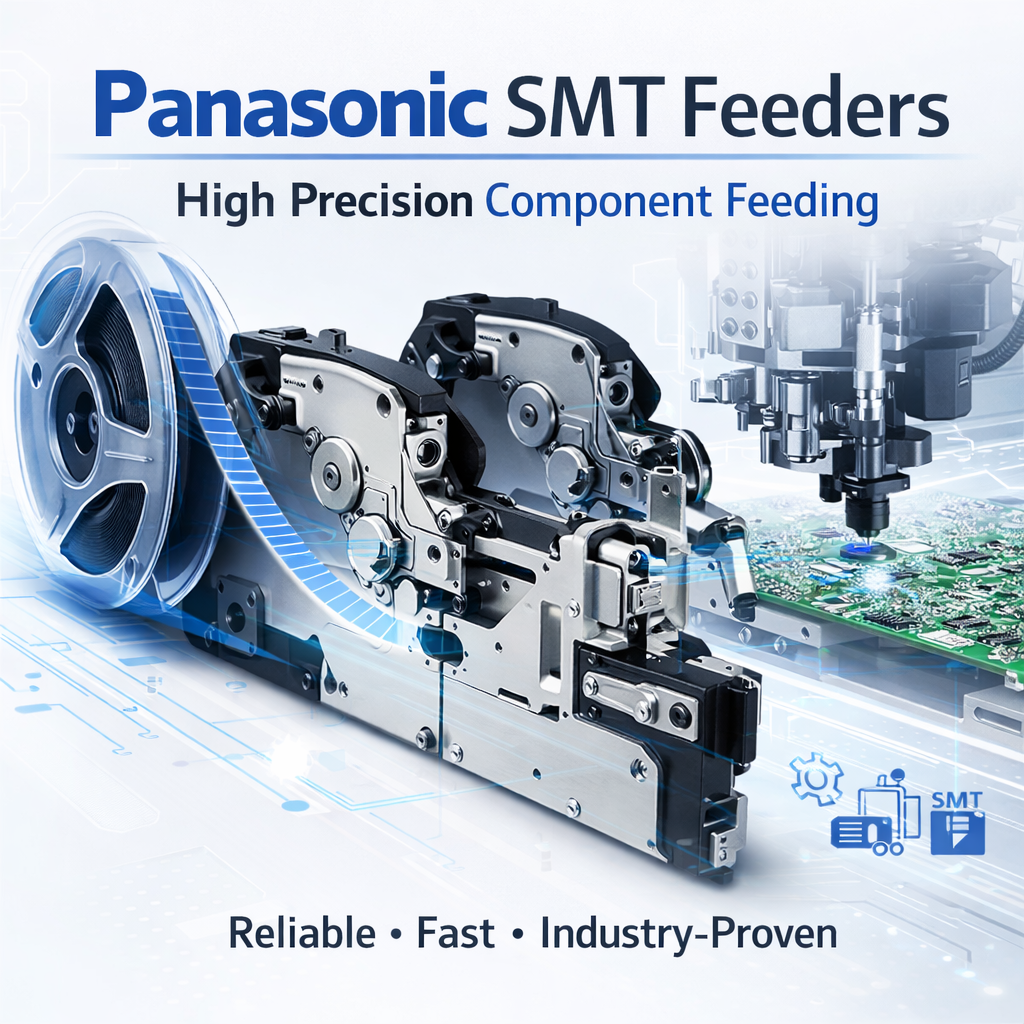
Panasonic SMT Feeders are designed to work seamlessly with Panasonic’s CM and NPM series pick-and-place machines. Their main role is easy; they feed parts to the placement head in an accurate and consistent manner. Manufacturing facilities that operate at high speeds need systems that provide dependable operation together with exact precision for fundamental tasks.
Types of Panasonic SMT Feeders
Not any feeders can be used in all the cases; you have to select the type according to your mixture of components and your aims of production.
1. Tape Feeders
The most widely used type, ideal for standard SMD components. Available in multiple sizes (8mm, 12mm, 16mm, 24mm, etc.), they handle reel-based components efficiently. They enable automated SMT lines to achieve continuous feeding through their high-speed design.
Best for: High-volume, standard production lines.
2. Stick Feeders
These feeders are meant for components that come in a tube or stick form. They offer efficient linear feeding, especially for non-taped components. Although they are reliable, they need more manual intervention than tape feeders.
Best for: Integrated circuits (ICs) and components not available in tape format.
3. Tray Feeders
The system handles delicate components that hold high value through its stable handling features. The system secures the parts and ensures they are not damaged during the picking process. They run operations that require precision in their processes.
Best for: BGAs, QFNs, and custom-packaged parts.
4. Vibratory Feeders
The system functions as specialized feeders that handle bulk components and non-standard components. It uses its vibration mechanisms to create alignment, which helps present components for pickup in accordance with specialized production requirements. The setup and tuning process demands specialized knowledge to complete successfully.
Best for: Irregular applications that do not use special packaging systems.
Key Specifications to Consider
Specifications are not just numbers – they affect equipment’s performance, speed, accuracy, and compatibility.
1. Pitch Accuracy
The system measures component movement through its precise measurement system, which uses advanced technical capabilities. Even minor deviations can cause pick failures.
2. Feed Rate
The system needs higher feed rates, which enable it to achieve faster placement speeds that support its operation in high-throughput production lines.
3. Feeder Intelligence
The modern Panasonic SMT feeders provide smart features that enable automatic component recognition and equipment status tracking to minimize operational setup mistakes.
4. Durability
It is built with industrial-grade materials that provide enduring operational stability throughout continuous machine usage.
Compatibility: CM vs NPM Series
The majority of buyers make this mistake – thinking all feeders work with all machines. Always verify which feeder will work with your machine type before purchasing.
CM Series Compatibility
The older CM machines need particular feeder types for their operation. The newer feeders show operational capacity, but their compatibility needs testing.
NPM Series Compatibility
NPM machines support highly designed smart feeders, which use advanced communication and automated operation systems.
Cross-Compatibility
The Panasonic SMT Feeders offer dual functionality for operation on both CM and NPM systems. The purchase process requires verification because of product compatibility issues. The operation of incompatible feeders results in two negative outcomes, which include operational errors and decreased efficiency.
Common Buying Mistakes to Avoid
A small mistake while purchasing can quickly develop into a production headache.
- Ignoring machine compatibility requirements before proceeding.
- selection based on product price instead of choosing the better-performing option.
- Neglecting feeder conditions when buying second-hand feeders.
- Not considering future scalability.
How to Choose the Right Panasonic SMT Feeders
The right choice requires you to find a middle ground between your present requirements and your upcoming production needs. Begin your assessment by checking your component types together with your production volume and machine model. The operational requirement of your line needs more emphasis on flexible operations than on rapid production output. High-volume operations require you to focus on maintaining equipment reliability together with operational performance throughout the entire process. The decision between purchasing new Panasonic CM/NPM Feeders or refurbished units requires you to evaluate your financial situation and the reliability of your chosen SMT feeder supplier.
Conclusion
The appropriate feeder doesn’t just meet your machine requirements-it complements and improves your overall SMT process. The selection of the correct Panasonic SMT feeders impacts not only the precision and velocity of your production but also your operational efficiency. Working with trustworthy. Panasonic CM/NPM feeder suppliers and manufacturers will offer both quality assurance and compatible products. It minimizes risk, enhances operational efficiency, and keeps your SMT production lines running smoothly.
FAQs
What is the difference between Panasonic CM and NPM feeders?
Panasonic CM feeders are typically designed for older CM series machines, while NPM feeders are more advanced, featuring smart functions like auto-recognition and better data integration.
Are Panasonic SMT Feeders compatible with all Panasonic machines?
No, not all Panasonic SMT feeders are universally compatible. Some feeders are specifically designed for CM or NPM series machines, while a few models support cross-compatibility.
Can I use refurbished Panasonic SMT feeders?
Yes, refurbished Panasonic SMT feeders can be a cost-effective option if sourced from a reliable supplier.