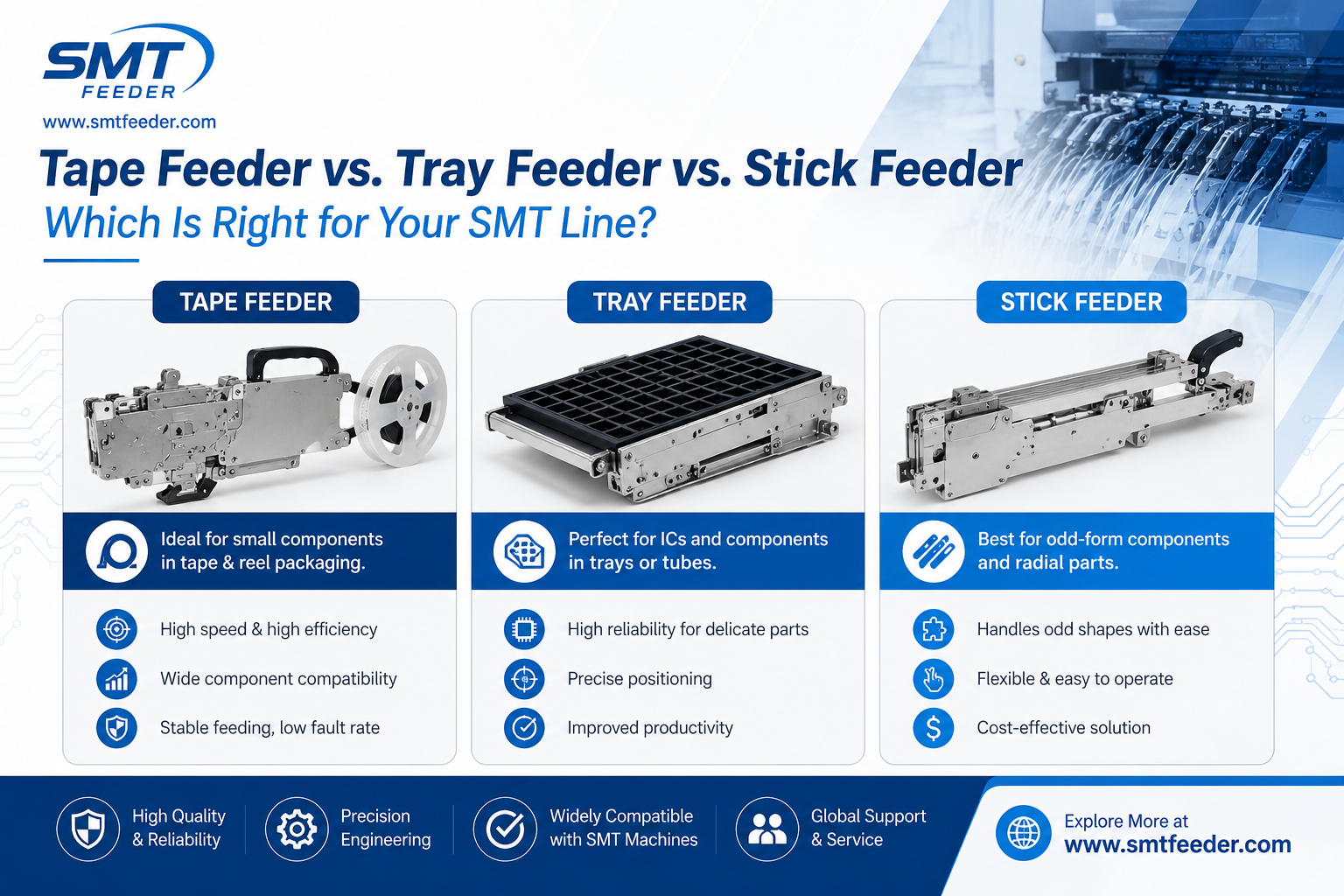

Tape feeders are the best choice for high-volume SMT production because they provide the highest speed, efficiency, and automation. Tray feeders are ideal for large, delicate, or high-value components such as BGAs and QFPs, while stick feeders work best for ICs and specialized components supplied in tube or stick packaging. The right feeder depends on component type, production volume, and line requirements.
Tape Feeders – Built for Speed and Scale
In today’s SMT lines, Tape feeders are the most popular type of feeders that is used for pick and place. They pick up components from carrier tape wound onto reels, usually in a width of 8mm, 12mm, or 16mm, and automatically move the tape to bring each component up to a constant pick-up point.
Tape feeders have various benefits for high-volume production runs:
- Component compatibility: Most common resistors, capacitors, and small ICs are packaged in almost all standard SMDs in tape-and-reel format, according to EIA-481.
- Speed: Tape feeders allow for continuous and uninterrupted component feeding with minimal operator interaction.
- Changeover time: It takes less than a minute to load a new reel, minimizing line downtime between batches.
If your line runs thousands of identical boards per shift, tape feeders are the default choice. They’re also the most affordable choice when buying components in bulk quantities.
Tray Feeders – Precision for Large and Sensitive Parts
Tray feeders, commonly known as waffle pack feeders, contain components in separate pockets in a flat plastic tray. They’re made to be used for components that can’t be handled by tape, such as QFP, BGA, TSOP and big IC packages where the integrity of the leads is important.
Single level tray feeders attach directly to the feeder rack. Multi-layer versions utilize an automatic tray transmission system to conserve floor space and deal with a greater number of tray components. Therefore, they are appropriate for:
- Complex assemblies with large, expensive, or fragile ICs
- Medical, aerospace, or industrial PCBs where component protection matters
- Low-to-mid volume runs with specialized part requirements
The trade-off is speed. Tray feeders operate slower than tape systems because each component requires a higher level of placement accuracy from the machine head.
Stick Feeders – The Niche Option for Legacy Parts
Stick feeders are used for components contained in hard plastic tubes. They can move individual parts, such as SOP, SOT, and PLCC packages, one by one towards the pickup position using vibration or gravity. These SMT feeders are not for high-speed production, but they are a practical solution to certain situations:
- Legacy or through-hole components unavailable in tape format
- Mixed-assembly lines with older component types
- Low-volume prototype or specialized runs
The major drawback: stick feeders are only suitable for non-polar, rectangular or cylindrical parts. They cannot be used with polar parts, which limits their use.
A Quick Comparison
| Feature | Tape Feeder | Tray Feeder | Stick Feeder |
| Best For | High-volume standard SMDs | Large/delicate ICs | Legacy or low-volume parts |
| Speed | High | Moderate | Low |
| Component Format | Tape & reel | Waffle trays | Plastic tubes |
| Changeover | Fast | Moderate | Manual |
| Cost Efficiency | Best for bulk | Higher per-unit | Limited scalability |
Which Feeder Do You Actually Need?
This will depend on three factors: Your component mix, Your production volume, and Your machine compatibility. Most modern SMT lines don’t use a single type of feeder – they will have a mix of tape feeders for standard parts and tray feeders for specialized ICs, with stick feeders reserved for legacy parts.
Quality of feeder hardware is as important as the type when sourcing or upgrading SMT feeders.
Conclusion
The selection of the wrong SMT feeder impacts not only throughput but also damage rates, misfeed frequency and overall line OEE. The feeder choice is a serious consideration when designing a new SMT line or evolving an existing line.
Ruihua Electronics Co. offers precision-grade SMT feeders – tape, tray, and stick designed with high-accuracy placement, durability, and compatibility. When you are prepared to maximize your pick and place feeder setup, reach out to Ruihua’s team for expert advice that is specialized to your exact production needs.
FAQ Section
What is the most common SMT feeder type?
Tape feeders are the most widely used SMT feeders because most SMD components are supplied in tape-and-reel packaging.
Which feeder is best for high-volume production?
Tape feeders are generally the best option due to their speed and automation capabilities.
When should tray feeders be used?
Tray feeders are ideal for BGAs, QFPs, large ICs, and sensitive components.
What are stick feeders used for?
Stick feeders are commonly used for ICs and specialty components packaged in tubes or sticks.
Can a pick-and-place machine use multiple feeder types?
Yes. Most modern SMT lines use a combination of feeder types.
Which feeder provides the best component protection?
Tray feeders typically provide the highest level of protection.
Do feeder types affect placement accuracy?
Yes. Stable feeding improves placement consistency and yield.
How do feeder types impact OEE?
Reliable feeders reduce downtime and increase machine utilization.
Which feeder is best for prototype manufacturing?
Tray feeders and stick feeders are commonly used for prototype and low-volume production.