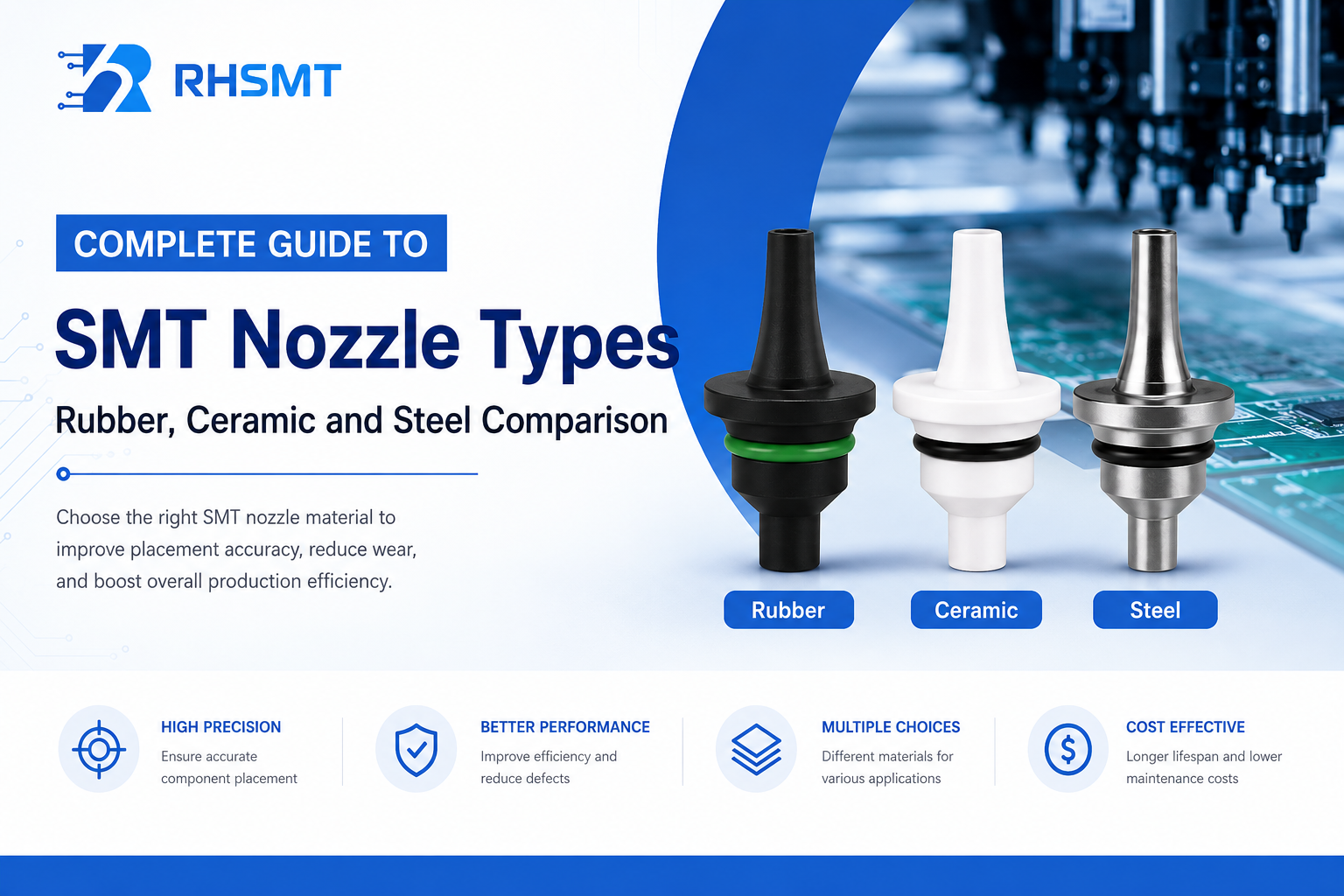

Ceramic, steel, and rubber SMT nozzles each serve different purposes in PCB assembly. Ceramic nozzles provide superior wear resistance and anti-static performance, steel nozzles offer durability and cost-effectiveness, while rubber-tipped nozzles are ideal for delicate, uneven, or sensitive electronic components. Choosing the correct nozzle material improves placement accuracy, production efficiency, and component protection.
What Does an SMT Nozzle Actually Do?
It’s important to know what you’re measuring before you compare materials. An SMT nozzle is mounted on the placement head of the pick and place machine. It is a vacuum lifting mechanism used to pick up a part from the feeder and drop it at a specific point on the PCB. Also, as the machine’s optical vision system acquires images of the component, the nozzle is the background reference; a dirty or worn nozzle has a direct impact on placement accuracy as well as pick reliability.
There are different nozzle models for each component size. These are predesignated for standard parts. Nozzles must be custom-made for non-standard or odd-shaped parts.
Steel Nozzles – The Workhorse of High-Volume Lines
Steel SMT nozzles, especially those made of tungsten steel and stainless steel, are the most popular used in normal production lines. They’re strong, resist wear, and are easily stacked for high-volume and speed runs of resistors, capacitors and small ICs.
The major disadvantage of tungsten steel is that it can become discolored with time, causing the tip to become white with surface contamination. This is not a function problem but may cause interference with the vision system image contrast. An easy solution is to use an oil-based marker on the area and keep using it.
Ideal for: High-volume production using standard SMDs, general-use PCB assembly and lines between 0201 and 0805 package sizes.
Ceramic Nozzles – Precision Without Static Interference
For applications that demand component sensitivity, ceramic SMT nozzles are the most preferred solution. They do not fade, ensuring the optical vision system keeps working properly. They are also anti-static, which is suitable for cleanroom application or for assemblies where sensitive ICs are present and electrostatic discharge can be a problem.
The limitation is fragility. Ceramic nozzles are brittle – the tip can crack or break if dropped or if mishandled. They need to be handled and stored carefully in the production process.
Ideal for: Fine pitch ICs, medical device PCBs, clean room assembly & where ESD protection is critical.
Rubber Nozzles – Grip Where Others Slip
Rubber (or silicone-tipped) SMT nozzles are designed to address a particular issue: uneven, curved, and sticky component surfaces that can be held securely by vacuum suction only with difficulty. The flexible tip slightly conforms to the surface, promoting contact and grip without introducing placement force that might damage the part.
The trade-off is lifespan. Rubber nozzles fail more quickly than ceramic or steel nozzles. If rubber tips are used frequently on these lines, it is standard practice to have extra rubber tips on hand; the tip can be replaced without replacing the nozzle body.
Ideal for: Connectors, irregular surfaces, some LEDs, sticky or non-flat parts.
A Quick Comparison
| Material | Durability | Anti-Static | Risk | Best Application |
| Steel (Tungsten) | High | No | Discoloration | Standard SMDs, high-volume |
| Ceramic | Moderate | Yes | Breakage | Sensitive ICs, cleanrooms |
| Rubber | Low | No | Wear/tear | Uneven or sticky components |
Conclusion
Choosing the right material for your SMT nozzle isn’t something to be taken lightly, as it will directly influence your placement accuracy, component-reject rate, and nozzle maintenance expenses. Once you’ve identified your component type, production volume, and quality requirements, you will be able to match the material to eliminate rework significantly.
Ruihua Electronics offers precision SMT nozzles in steel, ceramic and rubber, and they are compatible with the major machine brands such as Fuji, Yamaha, JUKI, Samsung and Panasonic. If you need expert guidance on your pick and place nozzle configuration, reach out to us for tailored recommendations.
FAQ Section
Which SMT nozzle material is best?
The best material depends on the application. Ceramic is best for precision, steel for durability and value, and rubber for delicate components.
Do ceramic SMT nozzles last longer?
Yes. Ceramic nozzles generally offer superior wear resistance and longer service life than standard steel nozzles.
Why are ceramic nozzles used for ICs?
Their anti-static properties and precision help protect sensitive electronic components.
Are steel SMT nozzles good for high-volume production?
Yes. Steel nozzles are durable, affordable, and commonly used in high-volume SMT assembly.
What are rubber SMT nozzles used for?
They are ideal for fragile, uneven, sticky, or irregularly shaped components.
How often should SMT nozzles be replaced?
Replacement depends on wear, suction performance, and production volume.
Can the wrong nozzle damage components?
Yes. Incorrect nozzle selection can cause pickup failures, misalignment, and component damage.
Which nozzle material has the best ROI?
For general production, steel often delivers the best balance between cost and performance.
Do nozzle materials affect placement accuracy?
Yes. Material quality impacts vacuum stability, wear resistance, and pickup precision.
Which nozzle is best for LED production?
Rubber and ceramic nozzles are commonly used for sensitive LED applications.e of their anti-static property and a constant image background.