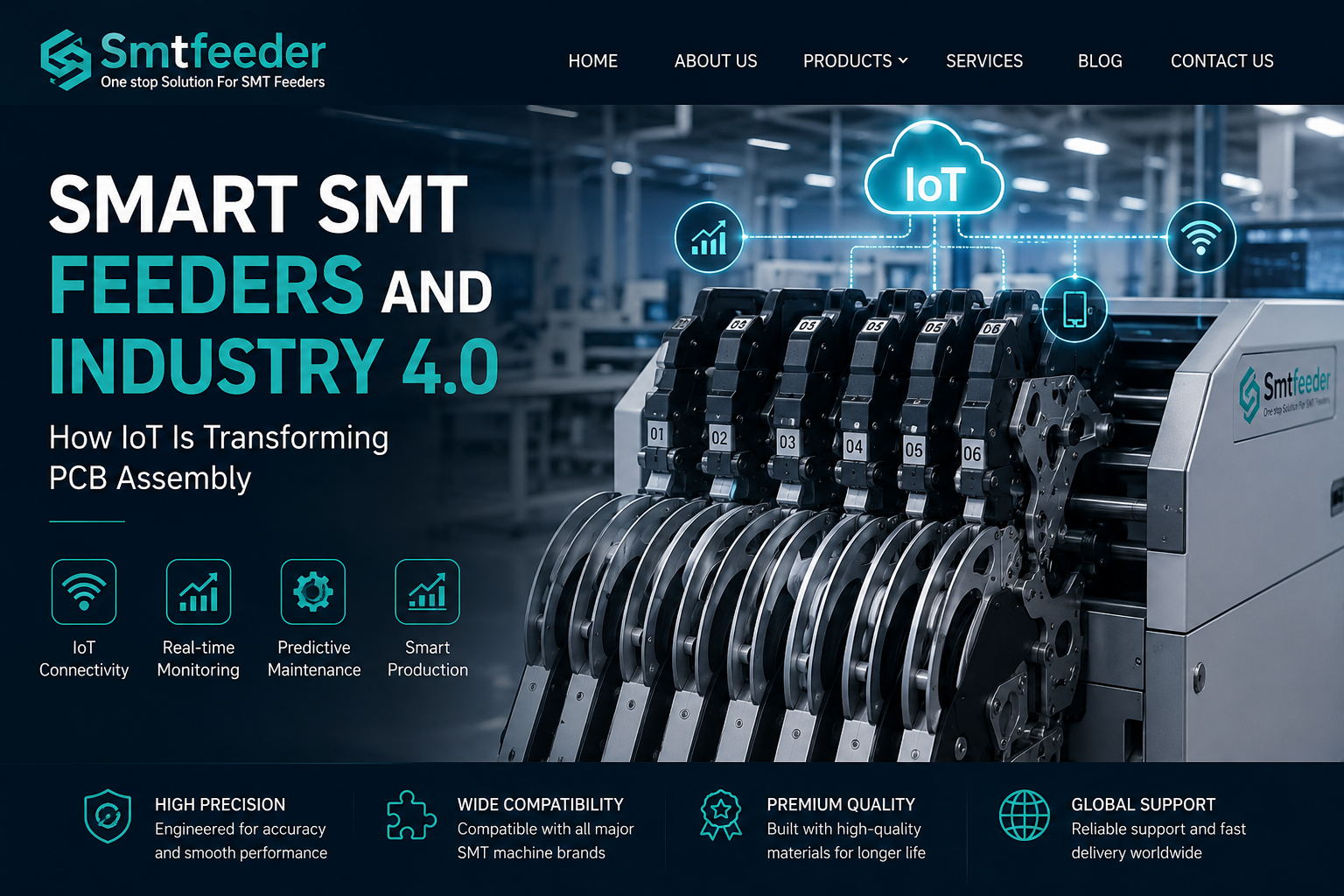

Imagine a PCB assembly line where machines don’t just run but think, communicate, and self-correct in real time. No unexpected downtime. No feeding errors. No quality guesswork. It is no longer the future – this is Industry 4.0-driven electronics manufacturing. SMT feeders are at the core of this revolution, as they have developed beyond mechanical component holders to become intelligent data-driven systems that have transformed precision, efficiency, and traceability in PCB assembly.
In the current competitive world of electronics manufacturing, a small mistake in feeding, at a microlevel, can result in a huge loss of production. This is why intelligent factories are fast moving towards IoT-based SMT feeders with a sophisticated inspection method such as AOI and SPI.
What Are Smart SMT Feeders in Industry 4.0?
The traditional SMT feeders are assigned the duty of correctly feeding components to the pick-and-place machines. Smart SMT feeders are, however, one step higher.
They are fitted in Industry 4.0 environments:
- Real-time monitoring of IoT sensors.
- Machine-to-machine communication capability
- Predictive maintenance alerts
- Components tracking and usage analytics.
This converts SMT feeders into smart production equipment.
How IoT Is Revolutionizing SMT Feeders
Smart manufacturing is based on the IoT integration. When applied to SMT feeders, it provides:
1. Real-Time Performance Monitoring
Speed of feeder, accuracy, and component consumption can be monitored by the operators in real time. Operators detect any deviation before it becomes a defect.
2. Predictive Maintenance
IoT-enabled SMT feeders monitor vibration, wear, and usage patterns to anticipate failures, instead of waiting to see them.
3. Seamless Machine Integration
SMT feeders are in direct communication with pick-and-place machines, eliminating setup errors and enhancing line sync.
4. Data-Driven Manufacturing
Actionable information is provided to production managers to maximize line balancing and minimize idle time.
Role of AOI and SPI in Smart SMT Assembly
To fully understand smart PCB assembly, two critical inspection systems must be considered:
1. AOI (Automated Optical Inspection)
AOI systems scan PCBs that have been assembled with high-resolution cameras to identify:
- Solder defects
- Misaligned components
- Missing parts
AOI data is returned to the system in smart factories to automatically adjust the SMT feeder.
2. SPI (Solder Paste Inspection)
SPI verifies the uniformity and accuracy of solder paste prior to starting placement of components.
It ensures:
- Accurate solder volume
- Proper alignment on pads
- Uniform deposition quality
When SPI data is linked to the SMT feeders, it assists in finding the root cause of defects prior to the commencement of the placement process itself.
Advantages of Smart SMT Feeders in PCB Assembly.
A combination of IoT, AOI, SPI, and smart SMT feeders provides quantifiable manufacturing benefits:
- Reduced total costs of operation.
- Quick and more efficient production cycles.
- Enhanced process traceability.
- Reduced assembly defects.
- Reduced unplanned production downtimes.
- Higher placement accuracy
The benefits are directly and quantifiably reflected in profitability in high-volume industries like automotive electronics, telecommunications, and consumer electronics.
Why Industry 4.0 Demands Smart SMT Feeders
The production of modern electronics is not only determined by speed but also level of accuracy, intelligence, and flexibility.
The systems needed in Industry 4.0 must
- Communicate across machines
- Real-time self-optimize.
- Reduce human dependency
- Assure defect-free production targets.
Smart SMT feeders are a perfect fit into this ecosystem as the intelligent supply chain of PCB assembly lines.
Conclusion
The development of SMT feeders into mechanical elements of smart, IoT-capable systems is a significant breakthrough in electronics production. Using AOI and SPI systems, intelligent SMT feeders create a self-corrective production system that eliminates defects and is highly efficient.
Industry 4.0 is not just factories in the modernized form; it is transforming them. And in the core of this change, SMT feeders have a silent yet potent role in guaranteeing that each PCB is of the highest standard of accuracy.
A production line, which still uses the old feeding systems, should be upgraded.
Upgrade your PCB assembly performance to a new level and invest in the recent SMT feeders, which are designed to be operated in intelligent production processes. The future of electronics production is intelligent, connected, and data-oriented – no one will be left behind.
FAQs
What are SMT feeders in PCB assembly?
SMT Feeders: Feeders are mounted on pick-and-place machines to feed electronic parts at the specific time when assembling PCBs.
What are smart SMT feeders’ advantages?
They use IoT sensors to provide real-time monitoring, predictive maintenance, and more coordination with production systems.
What is AOI in PCB manufacturing?
AOI (Automated Optical Inspection) is a machine that can visually inspect PCBs to identify flaws such as missing or misplaced parts.
What does SPI mean in electronics manufacturing?
SPI (Solder Paste Inspection) provides proper solder paste volume and placement prior to the components being bound on PCBs.
Why are SMT feeders important in Industry 4.0?
They are smart feeding systems that connect to smart factories, enhancing accuracy, efficiency, and traceability of production.