
FUJI SMT feeders are highly significant in current SMT manufacturing. With factories working to produce products faster, and with higher quality, the feeder is now one of the key components that controls how smoothly the line runs. FUJI is a brand that can be trusted, and its feeders are designed to provide consistent, quick, and precise feeding.
The production of SMTs is gaining speed and the size of parts is getting smaller. This means that feeders are of more importance than ever. They ensure that parts are delivered when required, they are lined up and continuously fed. This helps the entire line work without delay.
Understanding the Function of SMT Feeders
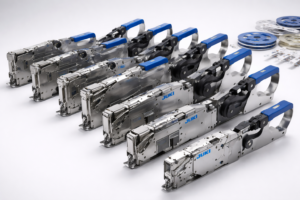
SMT feeders deliver parts to the pick-and-place machine. They keep each part in the right direction and right place, so the machine can pick it up correctly.
Common feeder types include:
Tape feeders – They hold parts in a long tape and feed them one by one. They are the most commonly used because they are fast and suitable for high-speed operations.
Tray feeders – They hold parts in trays. They are good for larger or delicate parts that cannot be moved quickly like small parts.
Stick feeders – They hold parts in a narrow tube and are used for parts that do not fit well in tape or tray feeders.
Key performance parameters affecting high-speed output include:
- Feed stability means the feeder moves parts smoothly without stopping or slipping.
- Error-free indexing means each part moves to the correct position every time.
- Pickup repeatability means the machine can pick up parts correctly each time.
- Compatibility with rapid placement cycles means the feeder can match the fast speed of the machine.
What Sets FUJI SMT Feeders Apart?
FUJI has a reputation for strong engineering and its feeders are built for demanding and fast production lines. They are compatible with FUJI NXT, AIMEX and XP machines which help minimize downtime and delays.
Their main strengths include:
- High precision components.
- Strong and steady build
- Smart tracking and automation.
- Modular design, which is easy to change.
All these features make FUJI feeders one of the best options in terms of speed and quality.
The Critical Role of FUJI SMT Feeders in High-Speed SMT Production
Ultra-High Component Pick Accuracy
FUJI feeders move parts at extremely high speeds. This minimizes pickup errors and helps improve quality.
Fast Changeovers for High-Mix Production
Factories usually deal with many products. Parts can be changed easily, without wasting time, using FUJI feeders.
Consistent Feeder Indexing and Smooth Component Feed
Precision indexing eliminates misfeeds, jamming or part loss. Smooth feeding also enables pick-and-place heads to run continuously without interruption, which is essential in ensuring tact times.
Robust Construction for Continuous Operation
The FUJI feeders are made with long lasting durability. Their robust design supports their heavy load duty cycles and lower maintenance needs and extend their service life. Such reliability is particularly useful.
Intelligent Feeder Features for Smart Factories
To support advanced manufacturing, FUJI integrates:
- Feeder ID and authentication systems
- Full traceability features
- Connectivity for Industry 4.0 workflows
- Automated error detection and operator guidance
These capabilities help manufacturers achieve higher consistency and visibility across the entire line.
Impact on SMT Production Efficiency and Throughput
FUJI SMT feeders assist in enhancing speed, precision, and overall production flow. They assist in the reduction of stops and errors resulting in improved production output and reduced costs.
Comparing FUJI SMT Feeders with Other Brands
FUJI SMT feeders are superior to most other brands in the sense that they are stable at very high speeds and they also have a long lifespan. They handle fine-pitch components with high precision and require less maintenance. This reduces the expenses in the long run.
They also operate well with the FUJI machines making the entire line perform in a better manner. Due to these merits, FUJI feeders are a powerful solution to any high demand and fast SMT line.
Common Applications Across Electronics Manufacturing
FUJI SMT feeders apply in consumer electronics in production of phones, TVs, and tablets. They assist in the delivery of parts in a manner that ensures products are produced at high speed with fewer mistakes.
They find application in automotive electronics, in making sensors and control units, where a high degree of accuracy in placement is required.
In the case of medical machines, FUJI feeders are employed as these types of feeders can handle small and fragile parts safely and dependably.
They are applied in the construction of boards in machines and robots in industrial control and automation systems. Their performance is constant and production runs well.
Due to the reliability and ease of operation of FUJI feeders, they are efficient in the large-scale production and mixed-product production.
How to Choose the Right FUJI Feeder for Your Production Line
To select a FUJI feeder, consider how fast and how much you need to produce. New feeders are preferable in case of high-speed production as they are smoother. For slower production, second hand feeders are economical, although you need to examine them.
Ensure that a feeder fits your FUJI device, such as NXT or AIMEX. Check how many feeders your machine can hold. Select the appropriate type of feeder: Tape feeders when small parts are involved, tray feeders when large parts are involved and stick feeders when special parts are involved.
It is important that the feeder is reliable. New feeders should be utilized and old feeders should be tested. When purchasing, it is always advisable to compare prices of different sellers and settle on one that will support it well after purchase.
Best Practices for Maximizing FUJI Feeder Performance
To maintain optimal performance-
- Conduct regular cleaning and visual checks
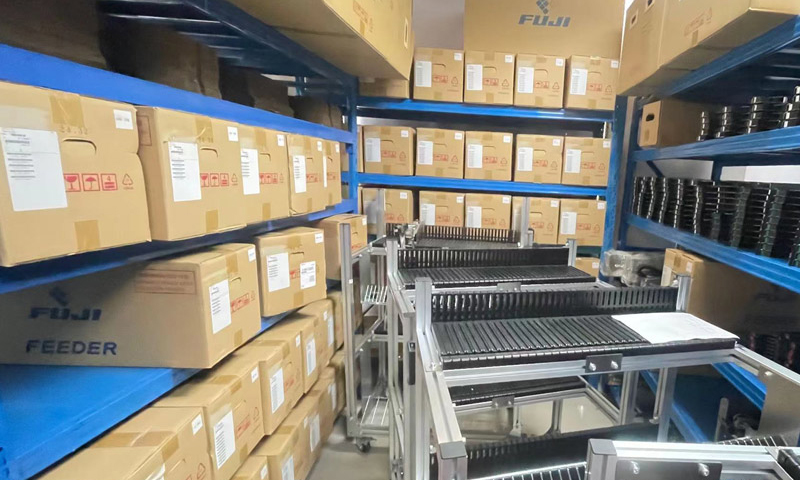
- Store feeders properly to prevent dust and moisture exposure
- Calibrate feeders periodically
- Follow recommended handling and maintenance procedures
- Track usage to anticipate wear and schedule timely servicing
- These practices extend feeder life and maintain stable feeding accuracy.
Conclusion
FUJI SMT feeders are vital to achieving high-speed SMT production performance. Their precision, mechanical stability, and advanced smart features allow manufacturers to maintain superior throughput and quality.
By integrating FUJI SMT feeders into your line, your company gains a competitive advantage through higher efficiency, reduced downtime, and long-term cost savings.
FAQs
Q. What is the purpose of an SMT feeder?
It presents parts in the right direction so the pick-and-place machine can place them correctly on the PCB.
Q. Why are FUJI SMT feeders preferred for high-speed production?
They give smooth, fast, and accurate feeding, which helps machines work at high speed without stopping.
Q. Are FUJI feeders compatible with all FUJI machines?
Most FUJI feeders work with NXT, AIMEX, and XP machines, depending on the model.
Q. How do FUJI SMT feeders improve production yield?
Their accurate feeding reduces misfeeds and placement errors, which improves output quality.