
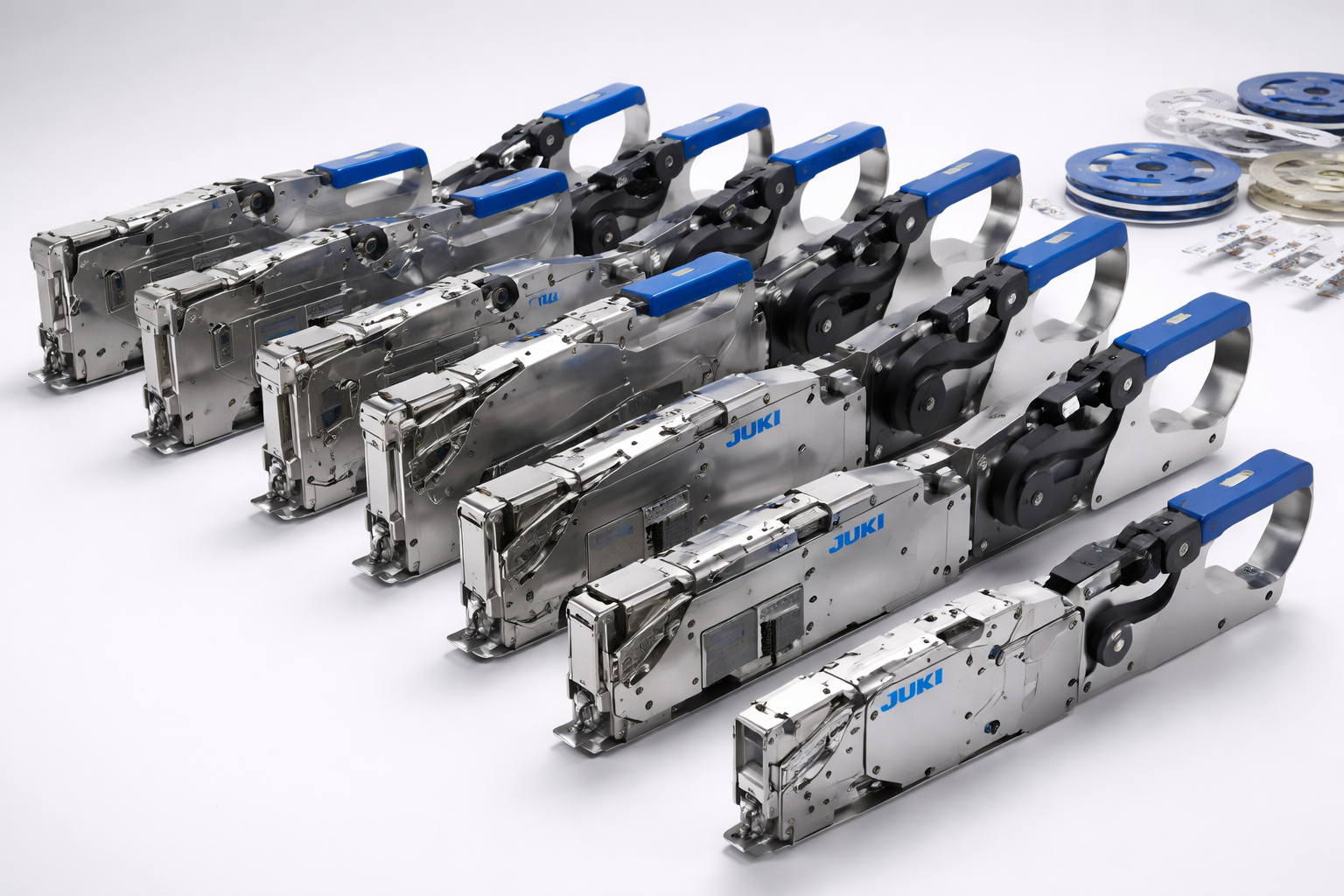

The JUKI SMT feeders are significant in modern PCB assembly as they provide a high degree of accuracy in the accurate positioning of the components and the overall production capacity. Nevertheless, most SMT lines unintentionally damage the accuracy of feeding, leading to flawed boards, causing more downtime and increasing operation costs. Knowledge of errors and best practices can play a great role in improving the quality of products and line performance in SMT.
Understanding JUKI SMT Feeders
The pick-and-place process cannot be completed without JUKI SMT feeders, which help in supplying components to the machine without interrupting pick-and-place operations.
What are JUKI SMT Feeders?
The JUKI SMT feeders are high-accuracy mechanical feeders designed to feed tape, reel, tube or tray based electronic components into the pick-and-place head in surface-mount technology (SMT). Their primary role is to place all the components in the position and orientation required by the SMT machine to place them correctly on the PCB.
Consider a feeder the “delivery hand” of the SMT line, with even an imperceptible component slippage, the entire assembly precision is impaired.
Types of JUKI SMT Feeders
JUKI offers a variety of feeders to accommodate different production needs:
- Standard feeders: Suitable for common components and high-volume production.
- High-speed feeders: Designed for fast SMT lines requiring rapid pick-and-place operations.
- Specialty feeders: For odd-form components or reels with non-standard dimensions.
Choosing the right feeder is critical; mismatched feeders can reduce accuracy and increase component misplacement rates.
How Feeding Accuracy is Measured
Feeding accuracy determines how consistently components are placed on the PCB. Key factors include:
- Tolerance levels: High-precision placements can have tolerances as low as ±0.05 mm.
- Placement precision: Misalignment leads to soldering defects or functional failures.
- Impact on PCB quality: Poor feeder performance can trigger rework and scrapping of boards, and delayed production schedules.
Common Mistakes SMT Lines Make
Feeding issues are often encountered by many of the SMT lines, not due to the machine, but due to small set-up and human errors, occurring during daily operations.
Improper Feeder Setup
Improper feeder arrangement is a major cause of many problems. In case the feeder is not correctly locked or placed in the incorrect slot, the machine will not pick up the parts in the right place. Even minor errors in aligning the tape or lining may be mispicked and placed. These problems can be prevented by taking time to install the feeder.
Neglecting Feeder Maintenance
Feeders require frequent attention in order to perform effectively. When dust and wear accumulate in the feeder, this happens when cleaning and lubrication are ignored. This causes the motion of parts to be rough and imprecise. Failure to maintain feeders usually results in jamming and breakages and increased machine stoppages.
Overlooking Component-Specific Challenges
Different components require different handling:
- Thin or odd-shaped components are prone to malfeeds.
- Poor quality tapes and reels may lead to jams or misalignment.
The fact that these nuances are ignored can lead to repeated errors in placing.
Consequences of Poor Feeding Accuracy
Components in the PCB may not be placed in the correct location when the feeders fail to operate properly. This leads to defects and the boards might require repair or rejection. Such minor errors in feeding can lead to large quality issues in the production process.
The machine also stops frequently due to poor feeders. Jams will have to be repaired by the operators or the feeder adjusted, which slows down the entire line. These halts decrease production levels on a daily basis and slow down orders.
This all contributes towards increased costs. Poor boards, wasted parts and additional labor raises the cost of production. Good feeder accuracy is important to maintain the line fast and reliable.
Best Practices for Optimizing JUKI Feeder Accuracy
Following the correct methods for setup, maintenance, and operation can greatly improve feeder accuracy and keep the SMT line running without interruptions.
Proper Installation and Alignment
The feeder should be properly positioned in the machine. When it is even marginally out of position, then the machine will not be able to select components correctly. Before starting the line, be sure that the feeder is fully locked and straight. Proper alignment ensures that there are fewer placement errors.
Regular Maintenance and Cleaning
Feeders accumulate dust during daily use. Small moving parts can be blocked by dirt, and this may cause feeding problems. Regular cleaning keeps feeders working smoothly and accurately.
Using the Right Feeder for Each Component Type
The various sections require separate feeders. A small feeder used with small resistors might not work with large ICs. The maintenance of appropriate placement is made accurate and safe by using the proper feeder in the proper part.
Monitoring and Adjusting Tape Tension
In long runs, tape tension may vary. The feeding process should be monitored and should be adjusted by the operator when necessary. Numerous pickup errorsNumerous pickup errors can be prevented with minor modifications.
Training Operators on Feeder Handling
The operators should understand how to load and operate feeders. The basic training will help them avoid simple errors and keep the line running smoothly.
Advanced Tips from SMT Experts
Calibration devices, periodic inspections, and machine software assists in maintaining the JUKI feeders in a good condition. Calibration tools ensure that the components are delivered to the correct location by the feeder and minor changes can be made when necessary. Periodical maintenance assists in the identification of weak or worn components before they become problematic.
Live information on pick errors and misfeeds is also displayed in the machine software. These warnings can be viewed by operators and fix the feeder quickly. These are easy measures that can be taken to prevent breakdowns and ensure smooth flowing production.
Conclusion
Numerous SMT lines have trouble with JUKI SMT feeders, since they do not consider proper set up, maintenance and issues specific to components. Companies such as SMT Feeder follow best practices and monitor feeder performance to guarantee the highest degree of accuracy, low incidences of defects and the production processes run more smoothly. Feeder accuracy is not only a technical consideration, but it is a significant factor in PCB assembly performance and profitability.
FAQs
Q1: How often should JUKI feeders be calibrated?
A: For optimal performance, calibration should be performed at least once a month or as recommended by the manufacturer.
Q2: Can feeder misalignment cause PCB defects?
A: Yes, even minor misalignments can lead to component misplacement, soldering defects, and higher scrap rates.
Q3: What’s the best way to handle odd-form components in SMT lines?
A: Using specialty feeders designed for odd-form parts and monitoring tape tension carefully prevents misfeeds.
Q4: How does tape quality affect feeder accuracy?
A: Poor tape quality can cause jamming, misalignment, or inconsistent component pickup, directly impacting accuracy.