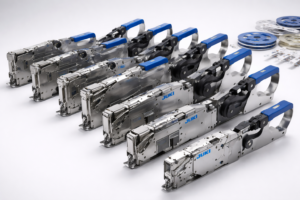
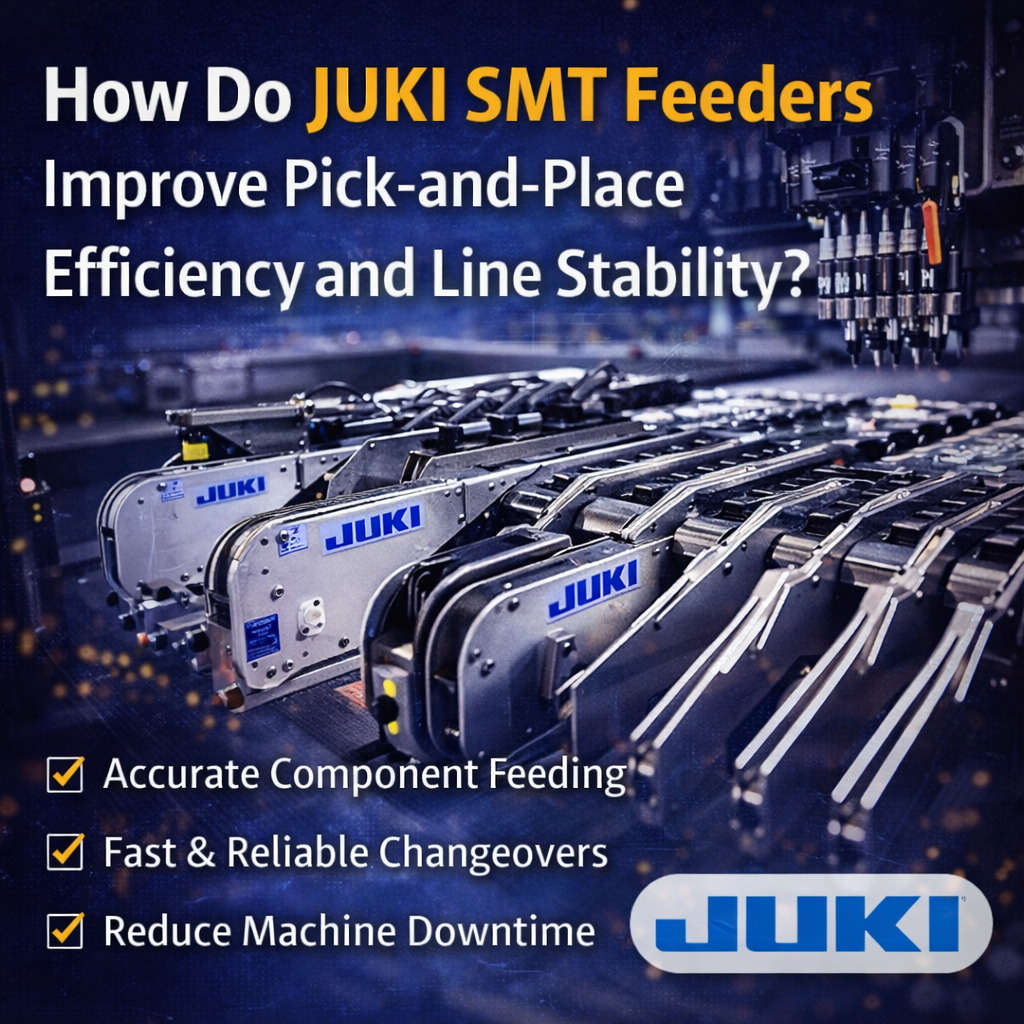

JUKI SMT feeders are an important part of the pick-and-place system, which has a direct effect on the production speed, accuracy, and line stability. In the case of electronics manufacturers, feeder performance may spell out the difference between smooth operation and expensive downtime. JUKI feeders have high-tech engineering and a stable design that maximizes pick-and-place efficiency with stable line performance.
We will discuss the role of JUKI SMT feeders in improving productivity, stability, and ROI which is measurable in electronics manufacturing line in this article
Understanding SMT Feeders
What Are SMT Feeders?
Surface Mount Technology (SMT) feeders are used to feed electronic parts to pick-and-place machines when assembling PCBs. They direct elements on reels, trays or tubes, making sure that they are placed accurately on the circuit board.
Why Feeder Quality Matters
Good feeders minimize misfeeds, enhance placement precision, and reduce unplanned downtime. A stable feeder ensures consistent production, resulting in reliable and efficient output.
Key Features of JUKI SMT Feeders
High-Speed Placement Capabilities
JUKI feeders are constructed to deliver components as quickly as possible, allowing pick-and-place machines to operate at maximum speed without errors.
Precision and Accuracy
These feeders are engineered with minimal deviation, ensuring components are delivered precisely, minimizing PCB defects and enhancing yield.
Reliability and Durability
JUKI feeders are robustly built, allowing longer production periods with less maintenance, ensuring consistent production and reduced line stoppages.
User-Friendly Setup and Changeover
Fast feeder loading and smooth adjustment mechanisms minimize setup times, allowing operators to handle different component types efficiently.
How JUKI Feeders Enhance Pick-and-Place Efficiency
- Faster Throughput: JUKI feeders transport parts to the machine at a faster rate, enabling the pick-and-place machine to operate more quickly. This translates to placing more components within a short period of time accelerating the process of production.
- Reduced Errors: JUKI feeders are very careful and precise when dealing with parts. This helps eliminate errors such as part misplacement or dropping, ensuring products remain correctly positioned and minimizing waste.
- Seamless Integration: JJUKI feeders are fully compatible with JUKI pick-and-place machines. They integrate well with the machinery, simplifying setup and preventing production line issues.
Example: In high-mix electronics production, JUKI feeders reduce machine downtime by over 15%, improving overall equipment effectiveness (OEE).
Contribution to Line Stability
- Consistent Performance: JUKI feeders are reliable and maintain a smooth flow on the production line. The reduced number of breakdowns results in reduced downtime.
- High-Mix Flexibility: These feeders can handle a wide variety of parts, from small to large batches. It becomes simpler to manufacture a range of products without causing any delay in the line.
- Operator Efficiency: Because the feeders are efficient, operators rarely need to intervene. This simplifies the work process and makes the production line unshaken.
Real-World Applications
In many industries where accuracy and consistency in component placement are required, JUKI feeders are used. In car electronics, they assist in the accurate placement of control modules and sensors which is very important in terms of safety and performance. They are also used in consumer electronics assembling smartphones, wearables and home appliances and provide fast and consistent manufacturing.
They are also necessary in the medical device sector where small and delicate parts must be fitted appropriately in small assemblies. With JUKI feeders, manufacturers are able to create high-quality products, make fewer mistakes, and avoid downtime.
Tips for Maximizing JUKI Feeder Efficiency
JUKI feeders should be maintained and calibrated regularly in order to achieve a high-performance level.This keeps the feeders operating correctly and eliminates unexpected issues that could slow production.
It is also important to use the correct feeder for the parts being worked on, depending on their size and production volume. Lastly, operator training on quick troubleshooting and changeovers will reduce downtime and keep the production line on track. Through these tips, manufacturers will be able to have a stable efficiency and reliability of their JUKI feeders.
Conclusion
JUKI SMT feeders are important in enhancing the efficiency of pick-and-place and line stability. They can provide a unified product of precision, reliability, and speed that guarantees a smooth production process and significant ROI to the electronics manufacturers. SMT feeders help companies maintain competitive production standards and avoid downtime and component errors.
FAQs
Q. What makes JUKI SMT feeders more reliable than others?
A. JUKI feeders are designed with precision engineering, durable components, and user-friendly changeovers, ensuring consistent operation and minimal downtime.
Q. How do feeders impact pick-and-place efficiency?
A. Feeder speed, accuracy, and reliability directly influence machine cycle time, placement accuracy, and production throughput.
Q. Can JUKI feeders handle high-mix, low-volume production?
A. Yes, their flexibility allows operators to switch component types quickly, making them ideal for high-mix manufacturing environments.
Q. Are JUKI feeders suitable for medical device assembly?
A. Absolutely. Their precision and reliability make them suitable for critical applications, including compact medical electronics.