
Every second of production time is valuable in today’s electronic manufacturing. A mere error in placement or in machine speed can affect output, product quality, and operating cost. The SMT nozzle is one of the most important factors to ensure both consistencies and performance.
The SMT nozzle is specifically designed to pick, transport, and place electronic components on printed circuit boards (PCBs) with accuracy. Manufacturers often find they are making placement errors, losing components, slowing down machines, and shutting down machines when nozzle performance is reduced.
For B2B manufacturers, contract electronics producers, and SMT assembly facilities, SMT nozzle efficiency is a practical solution to improve productivity while maintaining high quality.
This guide will cover the main aspects that influence nozzle performance and offer some practical steps to enhance the efficiency of your SMT production line.
Why SMT Nozzle Efficiency Matters
For most production managers, machine speed and feeder accuracy are major considerations. The SMT nozzle, however, often gets overlooked — until something goes wrong. If the SMT nozzle is worn, clogged, or not matched, it can cause:
- Warping or misplacement of components on board pads.
- Tombstoning and bridging during reflow.
- Increased scrap rate and rework cost
- Unplanned downtime and machine alarms
- Vacuum pressure failures mid-production
As per industry standards, nozzle defects can contribute up to 30% of SMT placement failures. It’s a big figure and one we can virtually eliminate if we get our strategy right.
Understanding the Main Causes of SMT Nozzle Inefficiency
It is necessary to find factors that are common across all nozzles that decrease their performance before making improvements.
Gain insight into the main causes of SMT nozzle inefficiency.
Identification of common factors that can decrease nozzle performance is important prior to making improvements.
1. Dust and Contamination
Although SMT production environments may seem clean, there is a constant accumulation of microscopic dust particles and solder paste residue, flux vapors, and airborne contaminants in the production environment during operation. With time, these deposits can impact nozzle performance and diminish the efficiency of the vacuum, which can result in inconsistent component pickup and placement errors.
2. Nozzle Wear and Damage
SMT nozzles run at high speed through the entire production process and are exposed to frequent mechanical stresses. Continuous contact with components and repeated pickup operations can gradually wear down the nozzle tip, affecting precision and reliability.
3. Incorrect Nozzle Selection
Each electronic component is different in size, weight, and surface finish. A nozzle that does not meet these specifications can cause vacuum instability, cause decreased accuracy in pickup, and can lead to defects in the placement during production.
4. Vacuum System Problems
The efficiency of an SMT nozzle relies mainly on the performance of the SMT machine vacuum system. If the vacuum pressure changes because of leaks, clogged filters, or poorly maintained pneumatic components, even a good nozzle is not going to work properly.
5. Improper Machine Calibration
Proper machine calibration makes the nozzle pick up and place parts at the correct coordinates as per the programmed machine movements. As the calibration settings change over time, it is common for manufacturers to have alignment problems, decreased placement accuracy, and wasted time during production.
Best Practices to Improve SMT Nozzle Efficiency
It is not always necessary to make significant process changes to improve SMT nozzle efficiency. A few proactive maintenance and optimization practices can help manufacturers improve placement accuracy, reduce downtime, and maximize overall production performance.
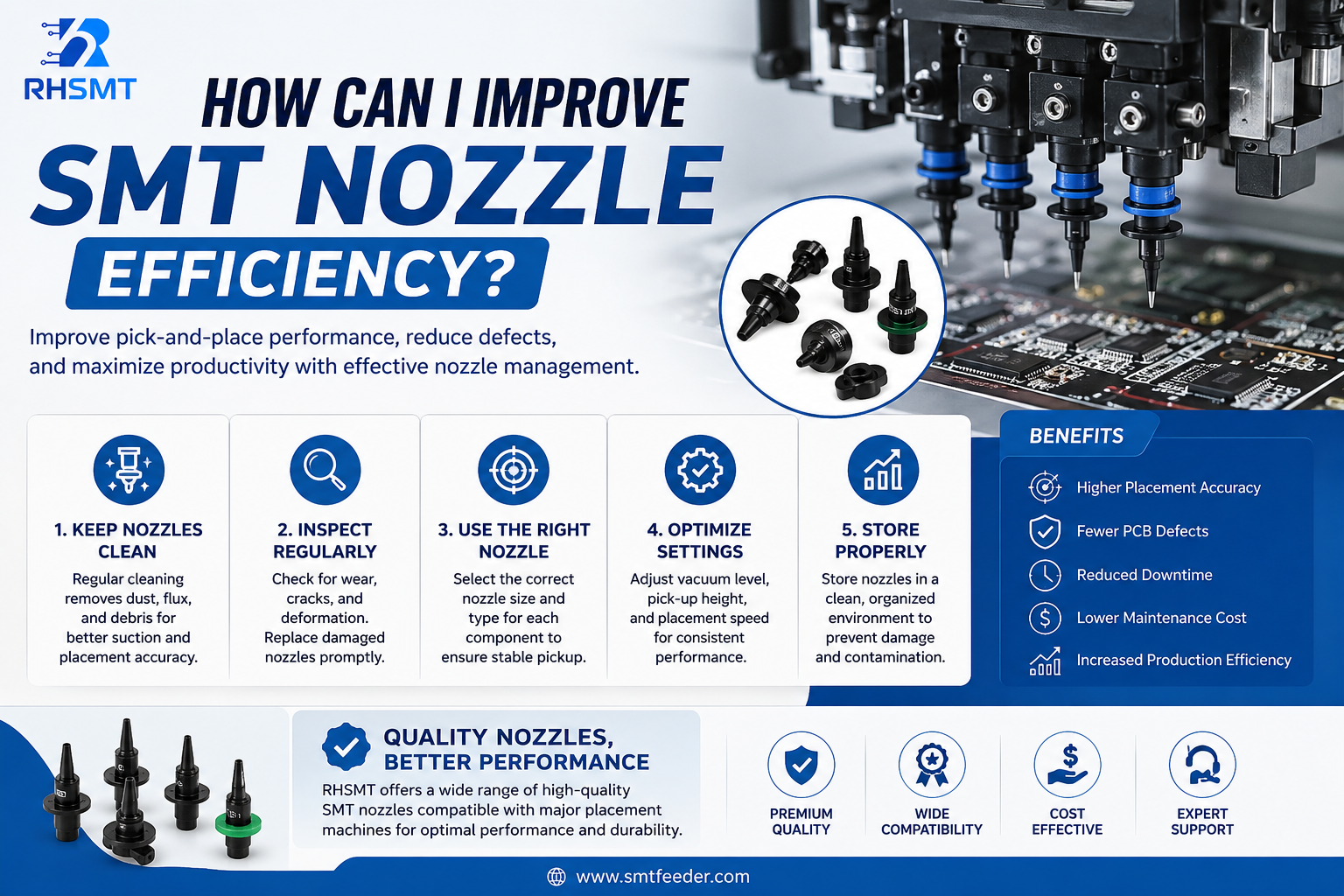
- Establish a Regular Nozzle Cleaning Program
Dust, residue, and microscopic particles can begin to impact nozzle performance over time without being noticed. Components can be picked up with greater reliability, vacuum strength remains stable, and contamination-related problems are not caused when picking up components, etc., through regular cleaning.
- Select the Right SMT Nozzle for Every Component
Various parts have different handling needs. The selection of the right nozzle size and shape increases the stability of the pickup, improves the placement quality, and reduces assembly interruptions during high-speed assembly.
Check the nozzle wear on a regular basis.
Over time, nozzle wear occurs and may not be seen until placement issues start to appear. Regular checks will help to detect any damage at an early stage and enable replacement to be planned of affecting productivity or assembly quality.
- Optimize Vacuum Performance
The nozzle will only work as well as the vacuum system that supplies it. Smooth operation along the production line, reduction of pickup failures, and maintaining consistent vacuum pressure are all assured when using the right components.
- Use Automated Nozzle Management Systems
When the production demand rises, manual condition monitoring of the nozzle becomes more challenging. Automated management systems offer greater visibility of nozzle use and maintenance requirements, enhancing team efficiency and minimizing unnecessary downtime.
- Maintain Accurate Machine Calibration
Accurate calibration helps to ensure components are picked and placed exactly where they are supposed to be. Proper calibration settings ensure consistent placement accuracy, reduce defects, and aid in maintaining consistent production performance over time.
How SMT Nozzle Efficiency Improves Overall Production Performance
Investing in structured SMT nozzle management delivers measurable returns:
| Benefit | Impact on Production |
| Higher placement accuracy | Fewer defects, lower rework cost |
| Reduced machine downtime | More output per shift |
| Longer nozzle service life | Lower consumable spend |
| Better process consistency | Improved first-pass yield |
| Faster changeover | Reduced NPI and setup time |
When Should You Replace an SMT Nozzle?
No matter how well maintained, each SMT nozzle has a limited service life. Replace a nozzle when you observe.
- Cracks, chips, or deformations at the tip are visible.
- Leaky vacuum around the cleaned area(s)
- Pick error rate above acceptable thresholds despite calibration
- Surface damage due to inadequate contact (scratches, dents, and bumps)
- Any obstruction in the internal channel that cannot be removed by flushing.
It isn’t cheaper to retain an old nozzle than to replace it. The expense of a quality replacement nozzle is minimal compared to the downstream cost of defects, rework, and downtime.
Future Trends in SMT Nozzle Technology
As electronics manufacturing continues to evolve, SMT nozzle technology is becoming more advanced. Emerging developments include:
- Smart Nozzles: Built-in monitoring capabilities give instant performance feedback.
- Advanced Materials: Use materials that provide wear resistance to enhance the life and longevity of service.
- AI-Driven Maintenance: Predictive maintenance systems are tools that can be used to anticipate potential issues before they arise.
- Automated Optimization: Optimal nozzle configurations are automatically determined by modern software for various production runs.
These innovations are helping manufacturers achieve greater SMT machine performance and operational efficiency.
Conclusion
To improve SMT nozzle efficiency, it is necessary to enhance the accuracy of the placement, reduce downtime, and maximize the production performance of SMT. Implementing basic practices, like consistent cleaning, choosing the right nozzle, routine checks, optimizing vacuums, and calibrating machines, can have a big impact on your operational efficiency and product quality.
Rather than treating nozzle maintenance as a routine task, manufacturers should view it as an important part of their overall production strategy. A well-managed SMT Nozzle program can lead to cost savings, reliability, and future manufacturing success.
Searching for reliable SMT nozzles and skilled manufacturing solutions? Ruihua Electronics offers excellent products and industry knowledge to assist businesses in enhancing their production efficiency, accuracy, and overall assembly performance.
FAQs
How often should SMT nozzles be cleaned?
SMT nozzles should be cleaned regularly based on production volume and operating conditions. Most manufacturers clean daily or weekly to ensure there is no contamination and to ensure that the pickup performance is consistent.
What causes SMT nozzle pickup failures?
The most frequent causes of pick-up failures are nozzles getting dirty, nozzle wear, vacuum leakage, a wrong nozzle selection for the application, or inadequate maintenance. Early detection of the cause can avoid placement issues and delays in production.
How do I choose the right SMT nozzle for a component?
The proper SMT Nozzle is determined by the size, shape, weight, and surface of the component. Ensuring that the nozzle matches the component results in stable pickup, accurate placement, and better overall production efficiency.