
If you run an SMT line, you already know one thing. The feeder makes or breaks your output. SMT feeders position the components and ensure they are delivered to the pick and place machine at the right moment. Choose the wrong feeder, and you will have jamming lines and missed placements and wasted time. Choose the right one, and the productivity of your entire assembly line increases.
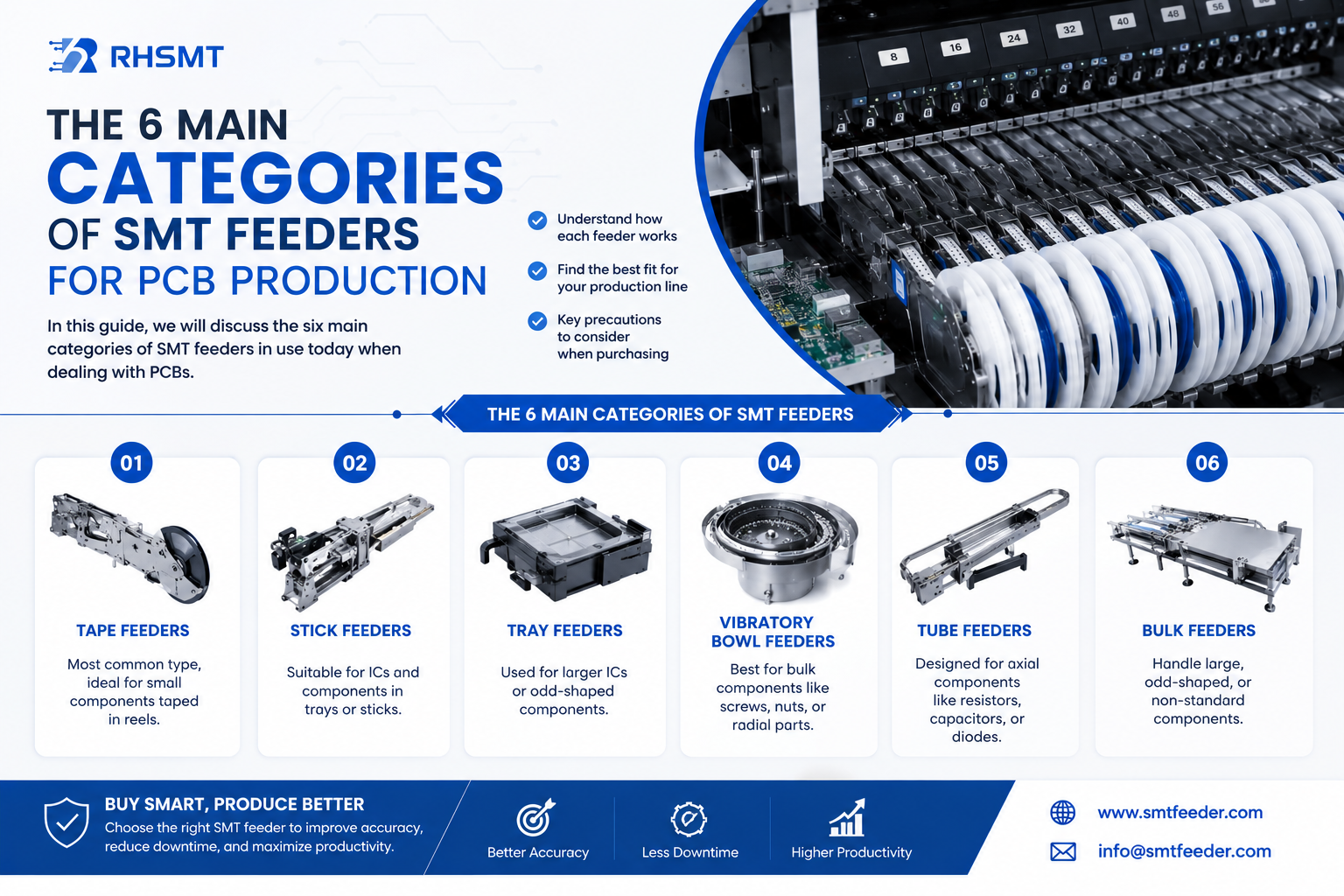
In this guide, we will discuss the six main categories of SMT feeders in use today when dealing with PCBs. You will know how they each function, how they best fit your production line, and some precautions to take when purchasing.
What is an SMT feeder, and why is it important?
The SMT feeder is a small but very important component of a pick and place machine. Its task is so straightforward. Keep items in their packaging, deliver them in proper sequence, and place each item at the pickup point. However, the actual job that lies behind the simple task is what makes the difference between a smooth production line and a struggling one.
Components come in different packaging types, including tape and reel, trays, tubes, sticks, or loose in bulk. It is necessary to make a feeder for each packaging style. A good resistor feeder will not work for a large BGA chip. This is why most manufacturers maintain a stock of more than one type of SMT feeder in their inventory.
Proper feeder selection cuts down the downtime, placement mistakes, and wastage of parts. Even the most advanced pick and place machine may not achieve its speed and accuracy objectives if it is not set up correctly.
6 Types of SMT Feeders Used in Modern PCB Assembly
Let’s take a look at the 6 most common feeder types you’ll be likely to encounter on a production floor.
1. Tape Feeders
Tape feeders are the most widely used type of SMT feeder – and it’s for a reason. Most chips (resistors, capacitors, diodes, and small ICs) are packaged in the form of a carrier tape wound on a reel. This tape is fed from a feeder that unwinds the tape, removes the protective cover film, and delivers each component at the pickup point in a perfect sequence.
The width of a tape feeder varies depending on component size and is typically in sizes of 8mm, 12mm, 16mm, 24mm, 32mm, 44mm, 56mm, and 72mm. Many modern lines use electric tape feeders instead of the older mechanical type, since electric versions index faster and place components more accurately.
Best for: high-volume runs with small to mid-size components.
2. Tray Feeders
Certain items are too large, too fragile, or too unwieldy to be wrapped in tape. Typically, large ICs, BGAs, QFPs, and connectors are packed in trays. These trays are placed in a tray feeder, and the feeder aligns the trays with the pick-and-place machine’s pick tip so that parts can be picked directly from the trays.
Tray feeders come in two basic styles. Single-layer tray feeders are placed on the feeder rack of the machine and suited for situations in which you do not have a lot of trays to load. Multi-layer, or matrix, tray feeders serve dozens of trays through an automatic feed system, which helps save on floor space on production lines that serve a high variety of parts.
Best for: large or sensitive components, low- to medium-volume runs, and prototype work.
3. Stick Feeders
Stick feeders handle components that come packed inside long plastic tubes or sticks, instead of tape or trays. The feeder uses gravity feed on a slight incline, causing components to slide down one at a time to the pickup position.
This type is well suited for DIP ICs, SOICs, and similar leaded ICs packaged in sticks. Note: One drawback of use with stick feeders is that they are not as flexible as tape feeders with orientation.
Best for: leaded ICs and through-hole components packaged in stick form.
4. Tube Feeders
Tube feeders work on a similar principle to stick feeders but are usually used for components like SOICs, PLCCs, and SOTs that need extra protection for their leads. These parts are loaded into tubes with their leads protected from damage, ensuring they move towards the placement head consistently.
Tube feeders are suitable for situations where feed protection is more important than feed rate.
Best for: Components requiring pin protection during feeding.
5. Bulk (Vibratory) Feeders
Bulk feeders are also known as vibratory feeders and are used for components that are not packaged at all but are placed directly into the bin or hopper. The feeder is equipped with a small mechanical guide and vibration to properly align each part before it is directed to the pickup point.
This feeder type is versatile and low cost and is utilized for custom components or repair where standard tape and reel packaging is not available. There is a balance between speed and accuracy. Bulk feeders are less consistent and slower than tape or electric feeders, which is why most manufacturers will not use them to achieve high reliability in their production.
Best for: non-standard components, low-cost setups, and repair or rework stations.
6. Electric (Intelligent) Feeders
Electric feeders are the new generation of SMT feeder technology. These feeders are designed with smart sensors, auto-calibration, and, in some instances, an auto-splicer and can identify tape end conditions, warning an operator when a reel is empty, and can even join a new reel without stopping the line.
In high-end SMT lines, especially in the automotive and consumer electronics sectors where uptime is critical, intelligent feeders have become standard equipment by eliminating the need for manual setup and minimizing human error.
Best for: high-speed, high-volume lines with a requirement for minimal downtime and strict quality control.
How to Choose the Right SMT Feeder for Your Line
Selection of the proper SMT feeder is not only based on the size of the components. There are some simple questions that can help decide if it’s worth it or not.
What packaging does your component come in: tape, tray, stick, tube, or bulk? What’s the speed of your line, and how do you feel about downtime? Are your components vibration-sensitive or ESD-sensitive? Is it a small-volume, high-mix job or a long run with a high volume?
Here’s a quick side-by-side comparison to make the choice easier
| Feeder Type | Best For | Speed | Component Examples |
| Tape Feeder | High-volume runs | Fast | Resistors, capacitors, small ICs |
| Tray Feeder | Large or sensitive parts | Medium | BGAs, QFPs, connectors |
| Stick Feeder | Simple non-polar parts | Medium | MELF diodes, small semiconductors |
| Tube Feeder | Leaded components | Medium | SOICs, PLCCs, SOTs |
| Bulk Feeder | Custom or low-cost parts | Slow | Loose, non-standard parts |
| Electric Feeder | High-speed production | Fastest | Mixed components, automated lines |
Most production floors have multiple machines from different manufacturers, and it is advisable to check the compatibilities of the feeders before purchasing them. Many manufacturers prefer SMT feeders, which can be used on various equipment brands, including Yamaha, Fuji, Panasonic, and Samsung, to avoid being tied to a single brand.
Common Challenges with SMT Feeders, and How to Avoid Them
Even with the right feeder type, things can still go wrong on the line. Some of the most common problems manufacturers encounter, particularly with older mechanical feeders, include tape jams, feeder misalignment, and worn-out springs. Taking the time and expense of regular maintenance and timely calibration greatly reduces the headaches.
Training matters just as much as the equipment itself. Without operator knowledge of correct loading/splicing/steps for maintenance, even the best SMT feeder will perform poorly.
Why Manufacturers Choose Ruihua Electronics for SMT Feeders
The choice of feeder type is important, but equally so is the selection of a feeder supplier that you can trust. Ruihua Electronics manufactures tape, tray, stick, tube, bulk, and electric feeders that are compatible with most of the major pick-and-place platforms, so you don’t need to redo your setup after switching equipment.
Each feeder is thoroughly inspected before leaving the factory, resulting in reduced jamming, fewer production downtimes, and greater placement accuracy on the line. Along with its fast turnaround, responsive after-sales service, and many advantages, it’s no wonder that many PCB assembly teams are turning to Ruihua Electronics for their feeder needs.
Conclusion
The selection of the appropriate SMT feeder is not an easy decision. It influences the speed of your line, the number of errors you are able to catch before they become rework, and the smoothness of your entire PCB assembly process from one part to another. There are six types of feeders (tape, tray, stick, tube, bulk, and electric) that each address a problem, which is why it’s important to know where they fit.
The other half is choosing equipment built to last. If the feeder jams every few hours or gets out of calibration, it will cost you more in downtime than it will save you initially in cost. That’s where the proper supplier can make all the difference.
Whether installing a new SMT line or replacing worn-out feeders, there is a feeder type for the job at Ruihua Electronics. Call their team today and discover which equipment is best suited to your production floor and enjoy a hassle-free experience running your line.
FAQs
What is the most common type of SMT feeder?
The most common type of SMT feeder is tape feeders because most chip components and ICs are packaged in carrier tape and reels.
What is the difference between tape feeders and tray feeders?
Tape feeders are used to pack small parts on tape, whereas tray feeders are used to pack larger or delicate parts, such as BGAs, which can’t be packaged on tape.
Can a pick-and-place machine use multiple feeder types?
Yes, most modern SMT lines do mix the feeder types on the same machine to perform different packaging for various components in one production run.
How often should SMT feeders be maintained?
Cleaning and calibration should be performed on a per-shift or weekly basis for high-volume lines, or as required by the manufacturer, to minimize jamming and ensure consistent placement accuracy.