
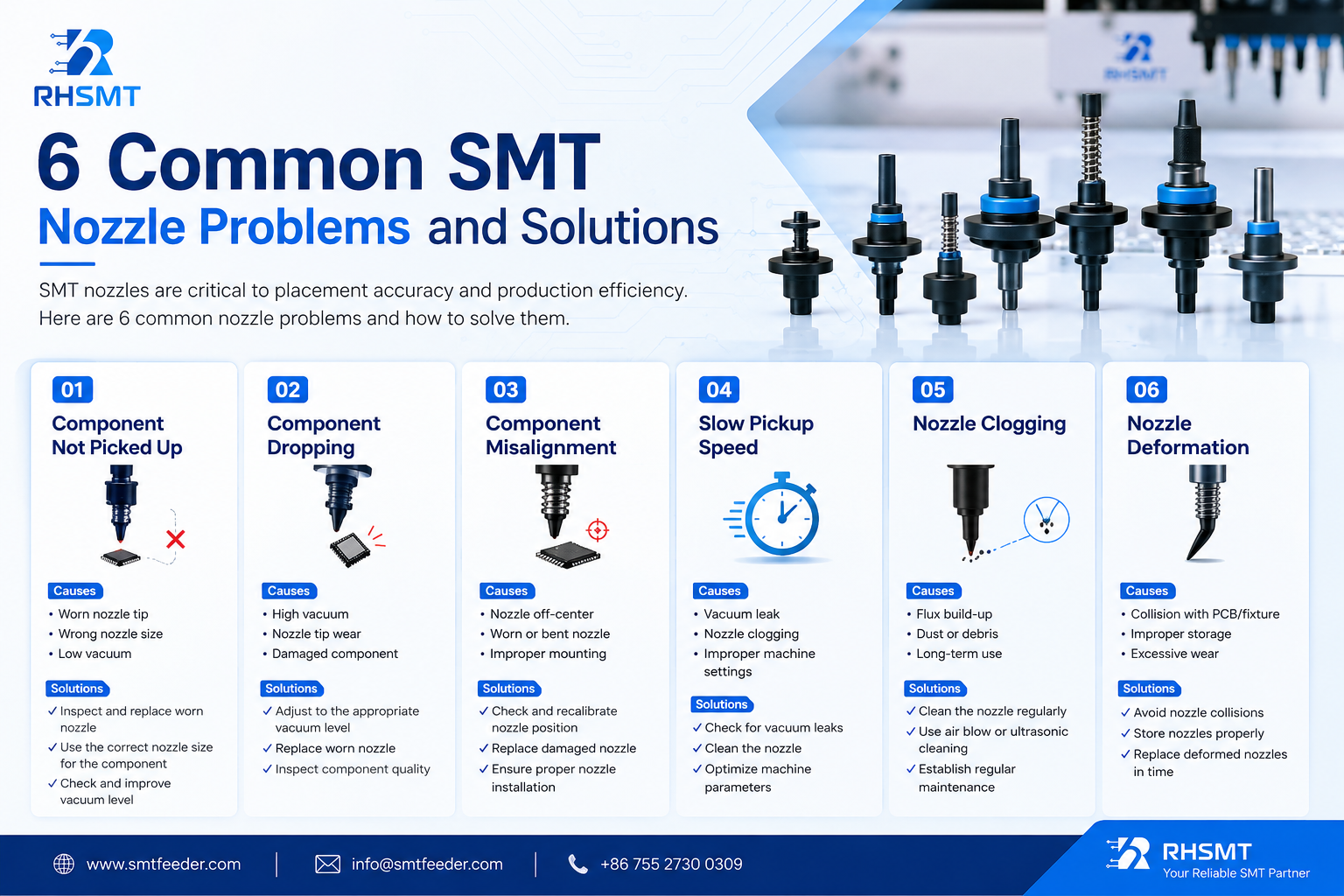

SMT nozzle problems such as vacuum loss, clogging, misalignment, nozzle wear, incorrect nozzle selection, and contamination can significantly reduce placement accuracy and production efficiency. Most issues can be prevented through regular cleaning, preventive maintenance, proper nozzle selection, and routine calibration of SMT pick-and-place machines.
What Is SMT Nozzle?
The SMT nozzle is designed to make it easier for the SMT machine to pick up electronic components by vacuum sucking and place them accurately on PCBs. It is essential to keep accuracy of placement and ensure smooth SMT manufacturing operations.
Detailed Breakdown: Problems and Solutions
1. SMT Nozzle Clogging
The most frequently encountered issue in SMT nozzles is clogging. The nozzle opening can be clogged by flux residue, solder paste, and dust particles over time.
Signs of clogged nozzle:
- Components are not being picked up correctly
- The vacuum pressure drops abruptly for some reason.
- A rise in the number of components placed incorrectly on the PCB.
Solution:
Thoroughly clean with an ultrasonic cleaner. To maintain the nozzle, wipe the nozzle tip with a lint-free cloth and an appropriate solvent. Don’t use sharp objects, which may harm the tip.
Set up a cleaning schedule based on your production volume. High-volume lines may require a daily cleaning.
2. Vacuum Leakage
The SMT nozzle adopts the mechanism of vacuum pressure to hold and place components. If vacuum leakage occurs, the nozzle can’t reliably collect parts.
Common causes:
- O-rings that are worn or damaged;
- Cracked nozzle body
- Vacuum line loose fittings
Solution:
Regularly check the nozzle and fittings around the nozzle. Change O-rings and seals as soon as they become worn. Perform a vacuum pressure test as part of regular maintenance to detect leaks in early stages.
3. Nozzle Tip Wear
All SMT nozzle tips will wear over time. If the tip is worn, it cannot form the correct vacuum seal, resulting in a loss of components and placement failures.
Solution:
Change the tip of the nozzle before it creates production issues. Most manufacturers recommend replacing nozzles after a certain number of placements. See your machine’s service manual for details.
Always install the proper nozzle size on the correct type of component. A mismatched tip will cause excessive wear.
4. Component Misplacement
The SMT nozzle alignment might be incorrect if the components are not being placed in the proper position. This is a precision problem, which deteriorates as it goes on if not controlled.
Common causes:
- Nozzle is not properly calibrated
- Vision system errors
- All debris lying under the nozzle tip
Solution:
Test your pick-and-place machine with a calibration cycle. Check the vision alignment system. Re-test nozzle-placement accuracy on a test board after cleaning off any residue from the nozzle tip before continuing production.
5. Nozzle Chipping or Cracking
SMT nozzles are precision parts but can chip or crack when impacted or operated with improper settings. Placement defects can occur with even a small chip.
Solution:
Change the nozzle right away if it has a chip or crack. If the nozzle is damaged, it can cause the placement of components to be inaccurate and may cause damage to the PCBs; thus, using it will increase the problem.
Review your machine speed settings and make sure you are using the right nozzle material for your application. There are various levels of durability for ceramic and stainless steel options.
6. Contamination Build-Up
Flux, oils, and other contaminants cover the surface of the nozzle over time. This buildup can impact the vacuum grip and even contaminate the PCB components.
Solution:
Use a preventive maintenance (PM) program. Have nozzles cleaned as part of routine maintenance. Use manufacturer-approved solvents. Do not leave nozzles in the open outdoors—this accelerates contamination.
SMT Nozzle Maintenance: Best Practices
It’s better to avoid problems than to solve them. The following are some simple practices to get a much longer life from your SMT nozzles.
- In high-volume production, clean nozzles every day.
- Before every shift, visually check tips for damage.
- Keep nozzles in protective cases when not in use
- Maintain a record of nozzle locations and need for replacement.
- Always use the right nozzles for the appropriate SMT machine model
- Use a reputable supplier with reliable quality and service
Conclusion
The proper maintenance of an SMT nozzle is essential to ensure the accurate placement of the components and smooth production while maintaining the quality of the PCB assembly. If not addressed timely, these problems may affect the performance of the SMT machine and cause downtime, such as vacuum loss, nozzle clogging, misaligned nozzles, and worn nozzle tips.
Good production efficiency and machine life is achieved by regular cleaning, timely inspection, and proper selection of nozzles. In addition, a well-maintained nozzle helps avoid placement errors and ensure stable manufacturing operations in SMT.
In order to provide reliable SMT solutions, Ruihua Electronics develops high-quality SMT nozzles and SMT spares, which are precise, durable, and long-lasting. Call Ruihua Electronics today for reliable SMT production assistance.
FAQ Section
What is the most common SMT nozzle problem?
Vacuum loss is one of the most common SMT nozzle problems because it directly affects component pickup performance.
How often should SMT nozzles be cleaned?
High-volume production lines should inspect and clean nozzles daily.
What causes SMT nozzles to lose suction?
Air leaks, worn seals, contamination, and damaged nozzle bodies are common causes.
Can a damaged nozzle affect placement accuracy?
Yes. Even minor nozzle wear can lead to placement errors and reduced yield.
How do I know when to replace an SMT nozzle?
Replace nozzles when pickup failures, wear, or placement inaccuracies become noticeable.
What is the best way to clean SMT nozzles?
Use approved nozzle cleaning tools and remove dust, flux residue, and debris regularly.
Can the wrong nozzle damage components?
Yes. Incorrect nozzle sizing can crack, drop, or misplace sensitive components.
Do SMT nozzles affect production speed?
Yes. Poor nozzle performance increases pickup failures and slows production.
Which SMT machine brands require specialized nozzles?
Panasonic, Fuji, JUKI, Yamaha, Hanwha, ASM SIPLACE, and I-Pulse systems commonly use machine-specific nozzles.
How can manufacturers reduce SMT nozzle failures?
Implement preventive maintenance, routine inspections, calibration checks, and operator training.