
SMT feeders are the core of any high-speed surface mount assembly line. They deliver components to the pick-and-place machine precisely, one by one, with thousands of cycles per hour. If feeders operate properly, then your line runs smoothly. If they do not, then all the downstream suffers.
What’s frustrating is that most of the feeder problems in SMT are not because of the faulty equipment. They are the result of unnecessary errors related to setup, handling, maintenance, and daily operation.
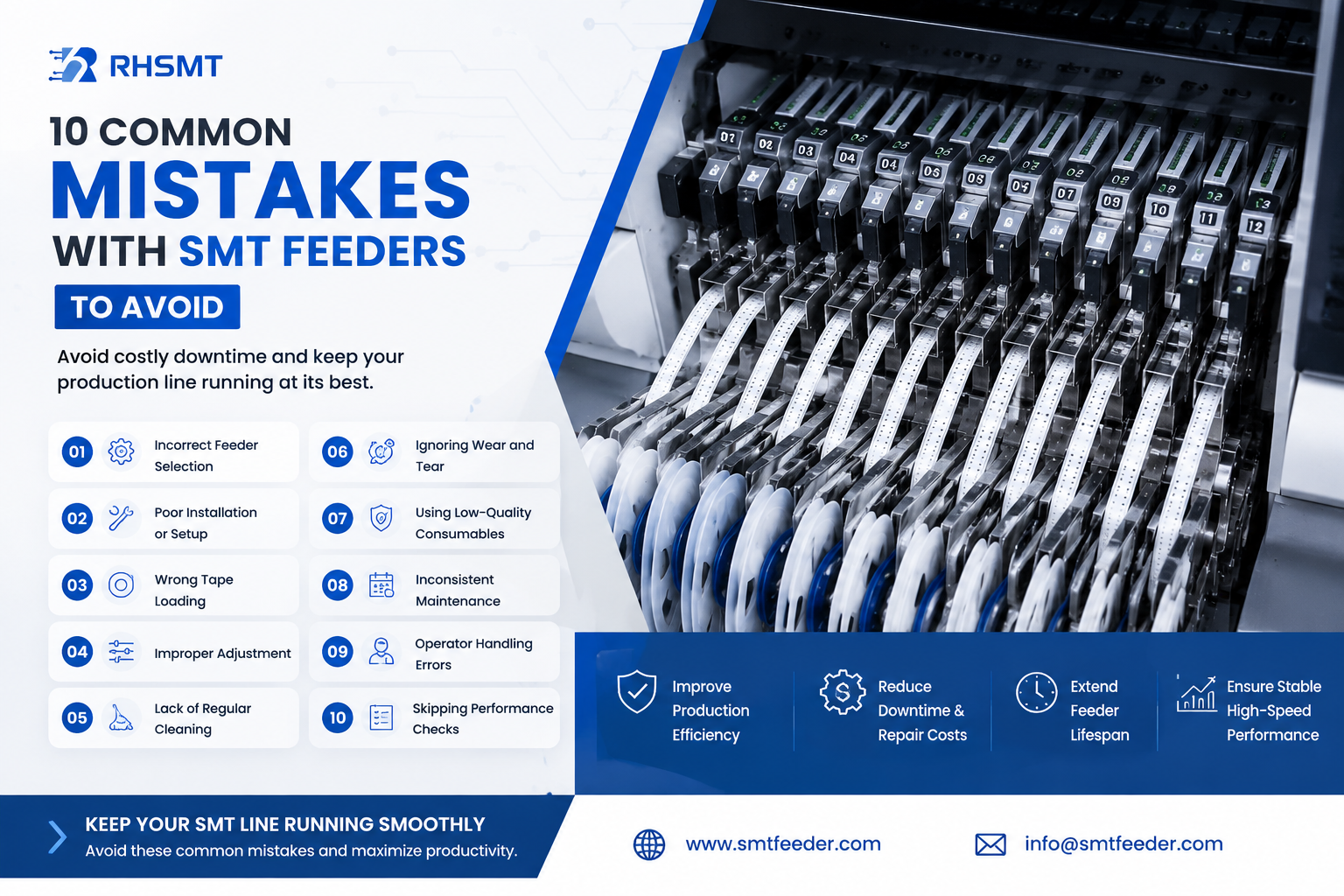
In this guide, we choose the 10 most popular SMT feeder issues that manufacturers face, explain what is causing them, and show you how to avoid them. This is the checklist for reducing feeder-related downtime in B2B electronics production lines.
Quick Overview: 10 Common Mistakes and Their Fixes
| # | Mistake | Quick Fix |
| 1 | Skipping feeder calibration | Calibrate before every new run |
| 2 | Irregular feeder cleaning | Clean tape guides weekly |
| 3 | Wrong feeder type for component | Match feeder to component format |
| 4 | Uncontrolled tape tension | Set tension per tape spec |
| 5 | Poor feeder storage | Use dedicated padded feeder racks |
| 6 | No operator training | Run structured setup training |
| 7 | Splice not logged in MES | Log every splice with position data |
| 8 | Running feeders with worn parts | Replace on schedule, not on failure |
| 9 | No preventive maintenance plan | Follow the weekly and monthly schedule |
| 10 | Ignoring machine error logs | Review pick data after every shift |
10 Common SMT Feeder Mistakes and How to Avoid Them
1. Skipping Feeder Calibration Before Production
The feeder that was running well on one job does not necessarily run well the next. Pitch indexing drifts, parts shift, and mechanical tolerances change between runs. A mere 0.1 mm error in feeder alignment is sufficient to result in placement inaccuracies with fine-pitch components. Calibrate before each run; it takes minutes but saves hours.
2. Irregular or Incomplete Feeder Cleaning
Each cycle, flux residue, debris from the tape, and dust accumulate inside the feeders. Without cleaning, tape channels jam up, sensors fail, and parts jam unexpectedly. These issues are prevented by a weekly cleaning of tape guides, rollers, and the areas of the sprocket. Use plastic-safe cleaning chemicals (generic solvents will damage plastic parts over time).
3. Using the Wrong Feeder Type for the Component
Tape feeders, tray feeders, and tube feeders are not the same. The wrong format for one particular component creates instability, double-picks, and dropped parts. This is particularly prevalent for larger components such as MOSFETs and connectors, where the wider tape format is not always supported with standard feeder set-ups. When programming a new product, always match the type of feeder to the component carrier.
4. Inadequate Control of Tape Tension and Peel Force
Tape tension directly affects the consistency of component delivery. Excessive tension causes tape rupture during reel transition, while insufficient tension produces slack in the tape path, resulting in skipped pockets or irregular feeding. Paper-based tape and embossed plastic tape don’t react in the same way to the same tension, so the peel force has to be set individually for each tape supplier and material type.
5. Improper Feeder Storage Between Production Runs
Mechanical damage can occur to feeders that are not adequately protected between runs and cannot be noticed easily. Some of the most common problems that result from poor storage practice include bent feeder frames, broken sprocket teeth, and cracked cover tape separating components. This is not a manufacturing defect; it is a handling and storage problem. Feeders should be kept in separate padded feeders, cleaned before storage, and dated when last fed.
6. Operators Not Trained Properly on Feeder Setup
Errors that occur in the threading of tapes, cover tape routing, and feeder loading are well-documented sources of feeder problems that occur in production processes. These errors occur when the training is hurried or undertaken as a single event. Every operator handling feeders should go through structured setup training, and that training should be repeated when new feeder models are brought onto the floor.
7. Not Logging Tape Splices in the MES
Without logging, the machine will not have any record of where a gap is in the tape path. This makes it hard to get the correct parts at the correct time, and once they are complete, it makes it hard to trace back. Record all splices at their location, feeder slot, and time stamp. Once spliced, slowly feed (index) for a few cycles and then go back to full speed.
8. Running Feeders with Worn-Out Parts
Sprockets wear down. Rollers lose grip. Sensors drift. The most expensive way to do it is to wait until these parts fail before replacing them. Feed errors are caused by worn components and are frequently attributed to machine or component problems, which wastes time on the incorrect solution. Replace them every time they reach their replacement cycle, regardless of how well they seem to be functioning.
9. No Preventive Maintenance Schedule
Feeders that are only fixed when they break are basically ensuring that there will be more downtime and increased maintenance over time. A set maintenance regime for SMT feeders (weekly cleaning, monthly check of calibration, and quarterly mechanical audit) replaces unexpected failures with expected maintenance. Document every activity. That documentation is what makes root cause analysis faster when something does go wrong.
10. Ignoring the Machine Error Logs and Pick Rate Data
Modern SMT pick-and-place machines maintain comprehensive pick error, feed failure and performance data of feeders. If this data is not reviewed on a regular basis, then recurring feed problems are not solved, as corrective actions are taken for the symptoms of the feed problem rather than the cause of the problem. To complete each production shift, feeder error logs and pick rate reports should be checked at the end of each shift.
Conclusion
This guide lists the top 10 errors that cause production problems in B2B electronics manufacturing when using SMT feeders. All can be avoided through systematic process discipline: correct calibration, planned cleaning, feeder selection, tape tension, and planned maintenance.
Manufacturers that tackle these areas will see reduced feeder downtime, increased placement accuracy, and reduced overall production costs. There is no major capital expenditure required to make the improvements. They need to have consistency in processes, documentation, and trained staff.
The quality of the components also directly influences the performance of the feeder. Even if it is serviced with care, a well-tolerated feeder will always perform better than a less-tolerated feeder.
Therefore, it is important to get the SMT feeders from a reliable supplier, as this is a part of a long-term production efficiency strategy. Partner with Ruihua Electronics to source better SMT feeders. They supply precision SMT feeders and compatible spare parts to B2B manufacturers across the globe.
FAQs
What causes most SMT feeder problems?
The most common cause of feeder problems in SMT is failure to perform adequate cleaning, improper tape tension, improper calibration, or worn mechanical components. Most of them can be avoided through regular maintenance and correct operator training.
How often should SMT feeders be calibrated?
Feeders should be calibrated before each production run. It is always good practice to have a full calibration test done as part of monthly maintenance, and any repaired feeder should be recalibrated prior to return to the line.
Does feeder quality affect placement accuracy?
Yes, directly. Feeders with incorrect pitch indexing or worn tape guides create placement offsets that result in PCB imperfections.
What is the best way to extend the SMT feeder’s lifespan?
The most effective ways to extend the life of the feeder are regular cleaning, replacing parts according to cycle counts, storing it on suitable racks, and proper operator handling. Quality feeders from trusted sources also have a long shelf life when using high-cycle production systems.